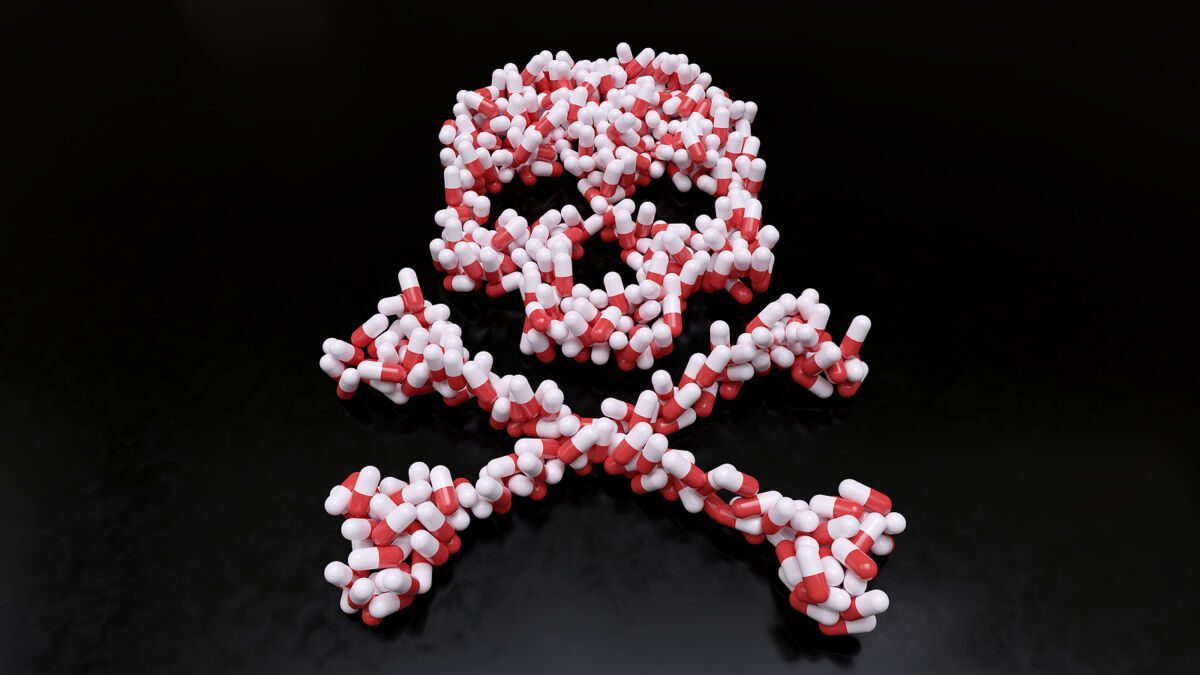
When there’s big money at stake, drug companies will hide the data and adopt mafia-like tactics to silence critics of dangerous drugs, as a new report reveals.
Doctors trust a new drug. After all, it’s gone through rigorous and expensive safety tests, there are reassuring studies that demonstrate the drug is effective—even if they have been paid for by the drug company—and salesmen will reward a prescription or two of the new drug with a new PC for the office.
And there’s always the razzamatazz that accompanies the arrival of a drug that’s celebrated as the great new hope for some chronic condition. Everyone likes a new drug, especially the manufacturer, who looks to get a third of its profits from it.
But there’s a dark side to the lucrative market in new drugs. Nearly one in three of these new drugs will kill the patient or cause life-threatening side-effects—even though it has gone through years of safety trials.1
It then takes an average of seven years before drug regulators act—and sometimes a dangerous drug stays on the market for a decade or more before it is finally banned, or an alert is issued. During that delay, hundreds of thousands of patients may have been killed or harmed by the drug as doctors unwittingly continue prescribing it.
This deadly hesitation is often the result of several factors: bureaucratic incompetence by the regulator and its cosy relationship with the drug company, the deliberate hiding of inconvenient data, and executives from the drug company threatening or bullying independent researchers who have discovered the drug’s dangers.
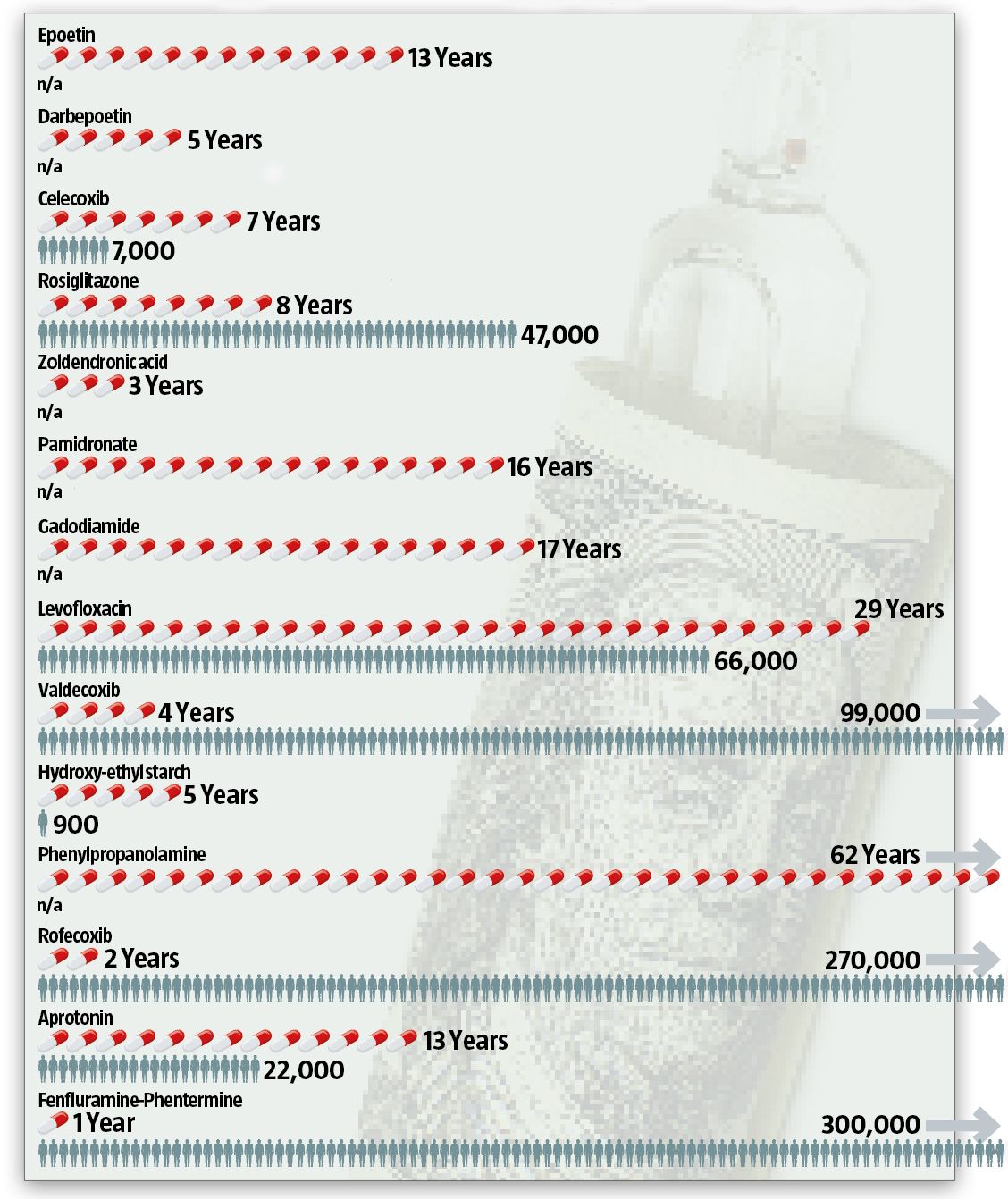
The chart shows the number of years it took the FDA to act on each dangerous drug and the deaths they caused (if reported)
But why would any company persist with a product it knew was a killer? The simple answer is money. A drug company will have invested upwards of $1.3 billion getting a single drug approved—and that doesn’t take into account the hundreds of other chemical formulations that failed during early testing, but that still would have cost the company around $150 million each.
Once it has been approved, a drug usually has only around 12 years left of its 20-year patent, and in that time the drug company must recoup the vast investment made in getting approval, pay for the many failures along the way, and deliver a sizeable return for shareholders. The drug company usually succeeds on all three fronts: new drugs make up a third of the profits of an industry that generates $11.5 trillion (million millions) in sales every year.
And if the company can keep the dangers of a new drug under wraps for a few years, it will have made back its investment—and any fine eventually leveled against it will represent less than a year’s revenues.
Researchers from the SONAR (Southern Network on Adverse Reactions) project, which represents drug researchers at 50 medical universities, tracked the history of 15 drugs and one medical device that had either resulted in payments of more than $1 billion in damages or had at least 1,000 reported cases of patients who had died or suffered serious reactions between 1997 and 2019.2
The researchers weren’t able to uncover the number of deaths and serious adverse reactions for half the drugs they monitored, but they discovered seven of them had killed or seriously harmed around 750,000 people before their dangers were exposed. These are conservative estimates, and other researchers have put the total at nearly double the SONAR team’s calculation.
The manufacturers paid out a total of $38.4 billion in damages, and there were criminal fines of $1.7 billion for the manufacturers of four of the drugs after failing to release data about their dangers to the US regulator, the Food and Drug Administration (FDA), or directly to physicians.
Twelve of the 15 drugs were given “black box” warnings, an FDA device that essentially tells physicians to prescribe them only if the patient might otherwise die, and six were eventually taken off the market altogether. Once the drugs were finally exposed as killers, sales dropped by around 94 percent.
But it took an average of seven years to get the FDA to react, and sometimes 16 years or more—and it was clear the regulators weren’t listening to those doctors who were seeing something very wrong about the new drug. Doctors who do try to warn the public can be bullied or threatened by drug company representatives, or, in the case of one doctor at a university hospital, lose her job, the SONAR team discovered.
It’s the patient who ultimately suffers, of course. One of the drugs, Fen-Phen (fenfuramine-phentermine), prescribed for weight loss, killed or harmed around 600,000 people before it was taken off the market. But doctors weren’t getting any alerts until that happened, and they continued to prescribe a drug that was causing lethal heart problems.
Doctors had been mystified by the sudden increase in heart problems in their patients, many of whom were middle-aged women who started to complain about shortness of breath that worsened over weeks. Many died or became seriously ill from cardiac failure, all the while taking Fen-Phen.
Another drug the SONAR team tracked was levofloxacin (Levaquin), a broad-spectrum antibiotic in the fluoroquinolone family that causes neurotoxicity—poisoning of the nervous system—resulting in agitation, severe nerve pain and even suicide. More than 60,000 people have reported serious side-effects, and around 6,500 patients have died from the drug.
It took 29 years before the FDA finally issued a black box warning, but despite the damage it can cause, levofloxacin is still classified by the World Health Organization as one of the world’s essential medicines.
Sounding the alarm bells about a drug’s dangers can be hazardous. In one survey, 61 percent of physicians who reported a drug’s dangers received personal threats from drug company executives, and one professor of medicine lost his academic post after his report about serious adverse reactions to a new drug was published.
Three physicians said they were threatened with lawsuits if they went ahead with their studies, while another abandoned the idea of publishing his findings because he feared a lawsuit. Instead, he told the FDA in person, as that got around his contractual obligations not to write about any adverse reactions to the drug phenylpropanolamine, a decongestant that researchers were discovering was causing stroke.
One of the most notorious cases is that of Nancy Olivieri, a pediatric hematologist who cared for children with leukemia, when she published a warning that deferiprone, an iron chelator, was causing severe liver damage in children enrolled in a drug trial.
The drug manufacturer sponsored a rival study that concluded the drug was safe, and Olivieri lost her job at the Hospital for Sick Children in Canada. Over the following 18 years, she was dogged by legal threats and attempts to have her medical license taken away. It was only in 2019—25 years after she raised the alarm—that researchers finally accepted she had been right all along.
Even before a drug is approved, researchers can be intimidated by the manufacturer. In one case, a researcher was threatened with legal action unless he omitted the name of the medical device that he discovered was dangerous during pre-approval safety trials.
Physicians who dare face down threats of lawsuits and worse don’t always find a welcoming refuge at the FDA. Five researchers who requested a meeting to report their findings about serious adverse reactions to three drugs—including rosiglitazone (Avandia), a diabetes therapy that killed or injured more than 47,000 patients—reported being snubbed by FDA executives.
Who is ultimately responsible for the colossal number of deaths and injuries that dangerous drugs cause? Is it regulators like the FDA, who often treat the pharmaceutical industry with kid gloves, or is it the drug company that deliberately hides incriminating data? Both, say the SONAR researchers.
In the case of Vioxx (rofecoxib), a COX-2 painkiller that conservatively killed or injured 270,000 patients, doctors were telling the FDA about the drug’s dangers for nearly three years before the agency banned it. All the while, the manufacturer was hiding the data.
Everyone is dropping the ball or looking the other way. Neither can be trusted with monitoring drug safety; instead, independent bodies such as institutional review boards need to be more involved in the whole process, and independent drug safety centers should be set up to protect the public, say the SONAR researchers.
And you can forget the idea of financial penalties being an effective way to keep drug companies in line. Although the drug companies that SONAR tracked paid out a total of $39.8 billion in fines and settlements and suffered $24.2 billion in lost revenues once the dangers of their drugs were revealed, these colossal sums still represent less than two years of revenues for the companies involved. And no pharmaceutical executive was fined—let alone jailed—for hiding data that could have saved the lives of hundreds of thousands of patients.
|
References |
|
|
1 |
JAMA, 2017; 317: 1854–63 |
|
2 |
EClin Med, 2021; 31: 100693 |
What do you think? Start a conversation over on the... WDDTY Community

Great news! Discounts are available based on your cart total. Check the details below: