You can drop the pounds, curb your appetite and get your blood sugar under control without surgery or drugs—and without horrifying side effects. Celeste McGovern reports
There has never been a more sedentary and overweight population than ours today in the West. When the US Centers for Disease Control and Prevention last counted, in March 2020, it found 42 percent of US adults over age 20 met the medical definition of obese, having a body mass index (BMI) score over 30. One in 10 more were classified as “severely obese” (BMI over 40).
This means more than 100 million American adults are obese, 22 million of them morbidly so.1 What about the children? One in five American children and teens—14.7 million—are classified as obese.2
And it’s a problem not confined to America. In England, almost 10 percent of five-year-olds entering school are obese. Before they enter junior high, Year 6, this figure bloats to more than 22 percent—higher than the US figures.3
These data don’t account for the overweight. In Canada, if you add fat people to the obese and morbidly obese, you’ve got almost two-thirds of the population, and the problem’s not slowing.4
What do the extra pounds mean for people? They mean a higher risk of dying; in the US, obesity claims 300,000 lives each year.5 Being overweight is linked to higher risks of heart disease, stroke, type 2 diabetes, dementia6 and Alzheimer’s, 18 types of cancer,7 osteoarthritis and sleep apnea,8 for starters.
It’s a financial burden for patients, too, and for their healthcare systems. In 2019, annual medical costs for obese adults were $1,861 higher per person than for those at a healthy weight, and $3,097 higher for the severely obese. This accounted for nearly $173 billion in medical expenditures.1
What if a pill or an injection could melt the pounds and the risks away? Enter Ozempic and its offshoots, the diabetes drugs approved by the US Food and Drug Administration (FDA) in 2021 for weight loss in adults and children as young as 12. Little wonder they’ve become a global phenomenon.
By 2023, sales of the drugs by the Danish company Novo Nordisk were in the billions. Their success bumped the entire economy of Denmark above the rest of Europe’s9 and spawned a whole new market of weight loss drugs that Goldman Sachs has forecast to generate $100 billion a year by 2030.10
Ozempic and Wegovy are brand names for different doses of the same drug, semaglutide. It’s a synthetic version of a molecule originally found in the venom of a large lizard, the Gila monster, that happens to mimic a human hormone, GLP-1 (glucagon-like peptide-1).
In humans, GLP-1 is one of dozens of incretin hormones, those secreted by cells in the intestines in response to food. Animal studies have shown that the brain is loaded with GLP-1 receptors, and it responds to the hormone by signaling to your body that you’re full. GLP-1 is the hormone that gives you a stuffed feeling after a big meal.
GLP-1 receptor agonist drugs like Ozempic and Wegovy mimic this hormone on an amped-up, super-physiological level, flooding the brain’s GLP-1 receptors. Even without food, they give the body all the signals it’s stuffed when it isn’t. This leads a person to eat less, lose weight and see their blood glucose and insulin markers move in a healthier direction.
“Glucagon-like peptide” sounds like glucagon, but they’re different hormones, although both are involved in regulating blood sugar. GLP-1’s primary action is suppressing glucagon.
When insulin was discovered in 1921, animal insulin preparations contained molecules first thought to be a contaminant. It was called glucagon (short for glucose agonist) because it boosted blood glucose. Over the next decades, research revealed glucagon is a critical hormone in its own right—the “second hormone” of blood sugar regulation, and critical in diabetes.
“What’s interesting is they’re produced right beside each other in these little pockets of cells within the pancreas, and yet they’re enemies in a way,” says Dr Benjamin Bikman, a researcher and professor of cell biology and physiology at Brigham Young University who specializes in metabolic disorders.
“They antagonize each other in almost every possible biochemical event. If insulin is trying to do something, glucagon is trying to stop it. If glucagon is trying to do something, insulin is trying to stop it.”
Insulin is the hormone of feeding and storing. It takes simple molecules and packs away energy. Glucagon is the hormone of fasting and burning. It breaks down more complex molecules for energy.
The late Dr Roger Unger, the famed endocrinologist who identified glucagon, published groundbreaking work on how this hormone influenced insulin secretion and on the significance of the ratio of glucagon to insulin. As he explained, “The whole metabolic status of anybody—animals, humans—is determined by the relative concentration of insulin to glucagon.”
Unger, a professor of internal medicine at UT Southwestern Medical Center, discovered in the 1970s that even if type 1 (so-called insulin dependent) diabetics were deprived of insulin, if their glucagon was inhibited, their glucose control was perfect.
“We couldn’t believe this,” Unger recounted to the Endocrine Society in 2012. “We had all been trained to believe that life without insulin was not possible.”11
“So, diabetes is as much a problem of too much glucagon as it is a problem of too little or not functioning insulin,” explains Dr Bikman.
Insulin has dominated the diabetes research landscape for decades, however, perhaps because pharmaceutically minded researchers didn’t see a way to control glucagon.12
Fast-forward to the 21st century and the discovery of incretins, including GLP-1, that suppress glucagon. The quest for drugs that behave like these hormones led to the Gila monster toxin copycat semaglutide and a handful of spinoffs, which the FDA approved for type 2 diabetes control in 2005. At a low dose, it was fairly good at regulating diabetics’ blood sugar.
Researchers observed that some patients on semaglutide were dropping weight as well. It was a happy coincidence but not one overlooked by drug developers, who saw an enormous opportunity in the expanding obesity pandemic market.
First they began promoting Ozempic off-label at jacked-up doses to the non-diabetic obese. Then they launched Wegovy—Ozempic patented at a multiples higher dose. At these doses, the drugs light up the GLP-1 receptors but also slow the progress of food through the GI tract to prolong the sensation of fullness.
After the FDA gave its blessing to Ozempic and Wegovy in 2021, the weight-loss drug bonanza was on.
Last year, Novo Nordisk asked the FDA to extend approval of its blockbuster drugs to overweight children as young as six. A caveat that the children must also take diet and exercise measures seems to have been thrown in to appease critics, who see the drugs as a Band-Aid for the huge problem of a toxic food landscape. More and more children are growing up fat and sick on a standard Western diet of processed food.
It’s just the next in a long line of medical solutions for excess weight (see below).
GLP-1 receptor agonist drugs can have dramatic effects on appetite, reducing food intake and altering choices to cause rapid weight loss. A 2023 study analyzed data from 3,962 people who participated in six randomized controlled trials. Among them, 2,562 received semaglutide (the high-dose Wegovy) and 1,400 received placebos.
The people taking semaglutide lost an average of 11.8 percent of their body weight (about 27 lb) compared to those on a placebo, which translated into about 3.5 inches off their waists. They also had improved health indicators like blood pressure, blood sugar levels, inflammation markers and cholesterol.13
Newer GLP-1 drugs, like tirzepatide, sold as Mounjaro or Zepbound, trimmed even more weight, according to a 2024 meta-analysis. Participants lost an average of 45 lb and 5.5 inches off their waists (along with greater side effects).14
Some 30–40 percent of people are described as “super responders,” losing more than 20 percent of their body weight. A subgroup of 10–17 percent, “non-responders,” drop less than 5 percent of their starting weight.15
Those with the highest BMI scores tend to lose the most weight, though it’s often not enough. If they were 300 pounds and lost 15 percent of that, they’re still 265 pounds. As Michael Greger, author of Ozempic: Risks, Benefits, and Natural Alternatives to GLP-1 Weight Loss Drugs, says, “They started out obese, and they ended up obese.”
But mixed results and relatively small losses are just the beginning of the downsides.
A closer look at the drugs’ usage and effects leads to disappointment—and even horror.
Weight loss happens, but it stalls over time. Most losses occur during the first months of treatment, then plateau around the 14-month mark.16 Continue the drugs, and the weight stays off. But stop, and it piles back on—sometimes worse than before.
Remi Bader, an American influencer on TikTok, told her viewers that she was prescribed Ozempic when she became prediabetic. She lost weight on the drug but regained twice what she had lost once she stopped taking it.
Ozempic and Mounjaro users are taking to TikTok and Reddit now, looking for support after stopping the drugs to deal with their massive food cravings and “ravenous hunger.”
“I cannot stay full,” influencer Claudia Oshry complained in a recent post. “I just had a 12 oz steak and I’m starving, so I’m eating popcorn. How are we staying full?”
Between 50 and 75 percent of people who take GLP-1 drugs stop within a year, according to a paper by researchers at Northwestern University and Harvard University.17
“The staggeringly high discontinuation rates of GLP-1 RA should raise alarms for clinicians, policy makers, and public health experts,” said Sadiya Khan, Northwestern University cardiologist and author of the paper.
“First and foremost, the high cost of these therapies is likely a large barrier,” according to Dr Khan. The drugs cost up to $1,400 for a month’s supply in the US, though in the UK and Canada, they cost less than a third of that.
“Also, unlike therapies that are used to treat blood pressure or cholesterol,” Khan added, “some individuals think they will stop taking them once they’ve lost weight, while others are only using them cosmetically and not for management of a chronic disease.”
Khan didn’t mention the side effects of the drugs, but looking at the FDA Adverse Event Reporting System (FAERS), these might be the bigger problem. Since 2019, the agency has received 37,694 adverse event reports on semaglutide alone.
Of those, 16,622 were logged as “serious,” including 505 deaths. They include septic shock, gastrointestinal blocks, pancreatitis, pancreatic cancer, blood clots in the lungs, blindness, anorexia, suicide, episodes of psychosis and depression, and more.
Add tirzepatide and liraglutide to the picture, and it’s even more grim: 47,781 and 37,267 adverse events, respectively, since 2019. FAERS says the reports don’t prove causation and some may be duplicates.
Tirzepatide is listed as a contributing factor on the death certificate of Susan McGowan, a 58-year-old nurse from Scotland who died after taking just two doses of the Eli Lilly drug known as Mounjaro.
A few days after her second dose, she was vomiting and in severe stomach pain. At University Hospital Monklands in Airdrie, Lanarkshire, she developed serious kidney issues and went into a coma, according to the BBC. She died later from multiple organ failure, septic shock and pancreatitis.
Australian Trish Webster, 56, began using Ozempic and later switched to the tirzepatide Saxenda because she wanted to lose weight to fit into a dress for her daughter’s upcoming wedding. She lost 35 pounds but paid for it with a lot of nausea, vomiting and diarrhea.
Then one day “she had a little bit of brown stuff coming out of her mouth, and I realized she wasn’t breathing, and started doing CPR,” her husband Roy told 60 Minutes Australia. “It was just pouring out, and I turned her onto the side because she couldn’t breathe,” he said.
Webster died that night, with “acute gastrointestinal illness” listed as the cause on her death certificate.
“Gastrointestinal (GI) events are well-known side effects of the GLP-1 class. For semaglutide, the majority of GI side effects are mild to moderate in severity and of short duration,” Novo Nordisk, the maker of Ozempic and Wegovy, said in a statement to Britain’s The Independent when reports of gastroparesis, or stomach paralysis, were raised about a year ago.
“GLP-1’s are known to cause a delay in gastric emptying, as noted in the label of each of our GLP-1 RA medications. Symptoms of delayed gastric emptying, nausea and vomiting are listed as side effects.”
Sometimes the nausea and vomiting are not mild. British actor Stephen Fry revealed that he was forced to stop taking semaglutide when he began vomiting up to five times a day.
Delayed gastric emptying—slowing of food through the gastrointestinal tract—is an intended effect of the drug. Dr Bikman says it’s a reason some people develop putrid breath and stinking “Ozempic burps,” because “you have food sitting in your stomach so long that it’s starting to fester.”
“The problem with these GLP-1 agonists is that it slows it down too much,” he adds. “You’re taking a natural slowing signal effect and sending it off the charts.” There are published case reports in which the stomach becomes paralyzed and severely slows digestion.18
Meredith Hotchkiss, 56, of Idaho, is one of hundreds of patients suing Novo Nordisk and Mounjaro maker Eli Lilly after she was diagnosed with gastroparesis. She has since been fitted with a tube to deliver food intravenously and has been hospitalized three times, according to The Daily Mail, including one time with life-threatening sepsis.
“It affects me socially,” she says, “because you go out with your friends, and what do you do? You go out to dinner, or you go to barbecues . . . all the holidays, everything revolves around food.”
One woman is suing because severe vomiting burned a hole in her esophagus. Others say the acid from so much vomiting degraded their teeth.
Even mild nausea can be hard to stomach indefinitely for some. “When people say, ‘My food cravings go away,’ that’s a nice way of saying, ‘I feel a little sick all the time, so I just don’t want to eat,’” says Dr Bikman. For many, it’s just not sustainable.
Besides gastrointestinal issues, there’s an alarming risk with GLP-1 agonist drugs that’s not talked about much: muscle loss. Losing weight without resistance exercise can lead to about 15–25 percent of weight loss from muscle mass, but with Ozempic and its cousin drugs, it’s up to 40 percent.
“To help put that in perspective, that’s worse than the amount of lean mass lost by people with malignancies like esophageal cancer that cause them to waste away,” says Dr Greger. It’s also comparable to “a decade or more of aging.”19
A new amusement on social media is spotting celebrities with “Ozempic face”—a characteristic aged and sagging face with hollowed cheekbones caused by loss of facial fat and muscle.
UK celebrity Sharon Osbourne has been complaining about how she lost 42 pounds taking Ozempic. “I’m too gaunt and I can’t put any weight on,” the 71-year-old told The Daily Mail. “I want to, because I feel I’m too skinny. I’m under 100 [lb] and I don’t want to be. Be careful what you wish for.”
A potential trouble, especially for women of postmenopausal age like Osbourne, is that if they do gain weight, it’s likely to return as fat rather than muscle. Putting lost muscle back on might be easy for a 20-something, but not for an older woman. Lost muscle also leads to bone loss and frailty, which has its own frightful risks, including falls, fatigue and a sedentary life.20
In the end, it’s about weighing the risks whenever you’re putting in something that doesn’t belong there. “Are the consequences you want worth the consequences you don’t want?” asks Dr Bikman.
He thinks that, at their original very low dose, GLP-1 agonists might help people in severe situations break deep-seated habits, beat cravings, make better food choices and change their lifestyles.
If you want to fix your glucagon-to-insulin ratio without the risks of the GLP-1 agonist drugs, what can you do instead? Altering glucagon secretion and lowering insulin via diet and lifestyle is possible. From a diet perspective, Dr Bikman offers three main principles:
Curb carbohydrates
Ketogenic and carnivore diets work by drastically cutting carbohydrates (carnivore diets consisting of all animal products have no carbs, and serious keto diets are restricted to under 30 g of carbs per day). They’ve been shown to reduce blood sugar levels and insulin resistance over time.
Simply cutting out refined sugars and highly processed carbohydrates from foods in boxes and packages, like pasta, rice, cookies and crackers, will lighten your carb load. It can lower blood sugar after meals, which reduces the demand for insulin and can prevent glucagon secretion triggered by low blood glucose.
Focus on low-glycemic foods. The glycemic index (GI) measures how quickly a carbohydrate-containing food raises blood sugar levels. High-GI foods cause a rapid rise, triggering the release of insulin. This, in turn, can lead to hyperinsulinemia if insulin is overproduced in response to frequent blood sugar spikes.
Low-GI foods release glucose more gradually into the bloodstream, which helps prevent large swings in blood sugar levels and reduces the need for large amounts of insulin. They include non-starchy vegetables such as leafy greens, cauliflower and broccoli.
If you’re not aiming for ketosis, choose whole grains such as quinoa and barley, legumes like lentils and chickpeas, and most fruits. Berries and apples work well, but avoid blood-sugar-spiking tropical fruits like mangoes, pineapple and grapes.
Fill up on fiber. Dietary fiber directly stimulates the L-cells in the gut that make GLP-1. Gut bacteria consume fiber and produce short-chain fatty acids including butyrate, which trigger the release of GLP-1. The end effect is feeling full longer.21
Fiber-rich foods are low-GI and can reduce blood glucose after meals, which may prevent excessive glucagon secretion. Eat vegetables like spinach, broccoli, kale, cauliflower and low-GI fruit, such as berries. If you’re not trying to stay in ketosis, whole grains, especially barley, lentils and beans, are high-fiber options.
Flaxseeds are a great high fiber food that doesn’t spike insulin.22 Flaxseed crackers are a satisfying substitute for the high carb, processed kinds (see recipe, below).
Sweeten with allulose or stevia. These are popular low-calorie sugar substitutes that don’t significantly raise blood sugar levels in humans. Allulose is excreted without being metabolized, and stevia is metabolized differently from sugar.23
One 2024 study in rats found allulose “mitigated the adverse effects of high-fat, high-sugar diets, including reduced body weight gain and improved insulin resistance.” The rats “exhibited lower food consumption and increased levels of glucagon-like peptide-1 (GLP-1), enhancing glucose regulation and appetite control.”24 Stevia was found to have similar effects in another study.
Allulose is approved for use in the US but not in the UK or EU. When using either sweetener, choose brands without additives, such as maltodextrin, that can raise your blood sugar.
Prioritize protein
Protein has little direct impact on blood glucose levels and can help prevent large spikes and dips. Consuming meat, fish, eggs and nuts with meals can slow the digestion of carbohydrates and reduce glucagon secretion by stabilizing the glucose supply. It also promotes GLP-1 secretion to help you to feel full longer.21
Sardines, which have soft, edible bones, are loaded with calcium, which has been shown to increase GLP-1 alongside protein.26
Don’t fear fat
Healthy fats like those found in olive oil, capers, avocado, macadamia nuts, seeds and fatty fish can also reduce the insulin response and help maintain more stable blood glucose levels.27
More natural ways to lose weight.
If weight-loss drugs for six-year-olds sounds off, think of other obesity treatments. Vagotomies (cutting one or more branches of the vagus nerve),1 laxatives and jaw wiring2 have all come and gone.
Gastric balloons and “lap bands” (all the rage when they were approved back in 2001) have been replaced with newer bariatric surgeries with fewer side effects. Gastric bypass and gastric sleeve operations, which cut out part of the stomach to make it smaller and/or reroute the intestines, were performed on 280,000 Americans in 2022.3
Weight-loss drugs have come and gone, too—often when the hidden side effects are discovered. Benfluorex (brand name Mediator) was an appetite suppressant released to the French market in 1976. Its manufacturer knew it came with fatal heart problems at least as early as 1995, but it wasn’t recalled until 2009.4
Fen-phen, a “miracle” diet pill from the 1990s, was recalled after 6 million Americans took it and some developed deadly heart valve problems, which the drug manufacturer knew about but didn’t disclose.
Ingredients
1 cup roasted flaxseeds
¼ cup ground flaxseed meal (you can grind the seeds in a coffee grinder)
2 Tbsp Everything But the Bagel seasoning
½ cup warm water
Sea salt (optional)
Method
1. Preheat oven to 350 degrees F (177 degrees C). Line a baking sheet with parchment paper.
2. Combine flaxseeds, flax meal and seasoning. Mix in the warm water. Allow the mixture to stand for 10–15 minutes.
3. Spread the mixture over the lined baking sheet. Place a second sheet of parchment over the mixture and roll out to about 4 mm thickness. Remove the top sheet of parchment.
4. Make perforated lines with a fork for easy breaking after baking. Sprinkle with sea salt if you like.
5. Bake for 15–20 minutes, checking frequently after 15 minutes. Remove when slightly golden around the edges.
6. Cool slightly and then break into cracker-sized pieces. Store in an airtight container for up to one week.
Vinegar, with components known to have antioxidant, antidiabetic, antimicrobial, antitumor, anti-obesity, antihypertensive and anti-inflammatory effects, has been used to treat obesity for centuries.1
Bacteria in the gut turn acetic acid in vinegar into acetate, the same short-chain fatty acid they make from fiber, turning on GLP-1 and other incretin hormones that suppress glucagon and appetite.2
An effortless way to get vinegar into your diet is to have pickles before or with meals (just avoid ones with polysorbate 80 and carrageenan, which can mess up your microbiome).
In the diagram below, the French biochemist and author Jessie Inchauspé, known as the Glucose Goddess (glucosegoddess.com), has shown how her own blood sugar spike is flattened by drinking a tablespoon of white or apple cider vinegar in water or sparkling water 10 minutes before eating.
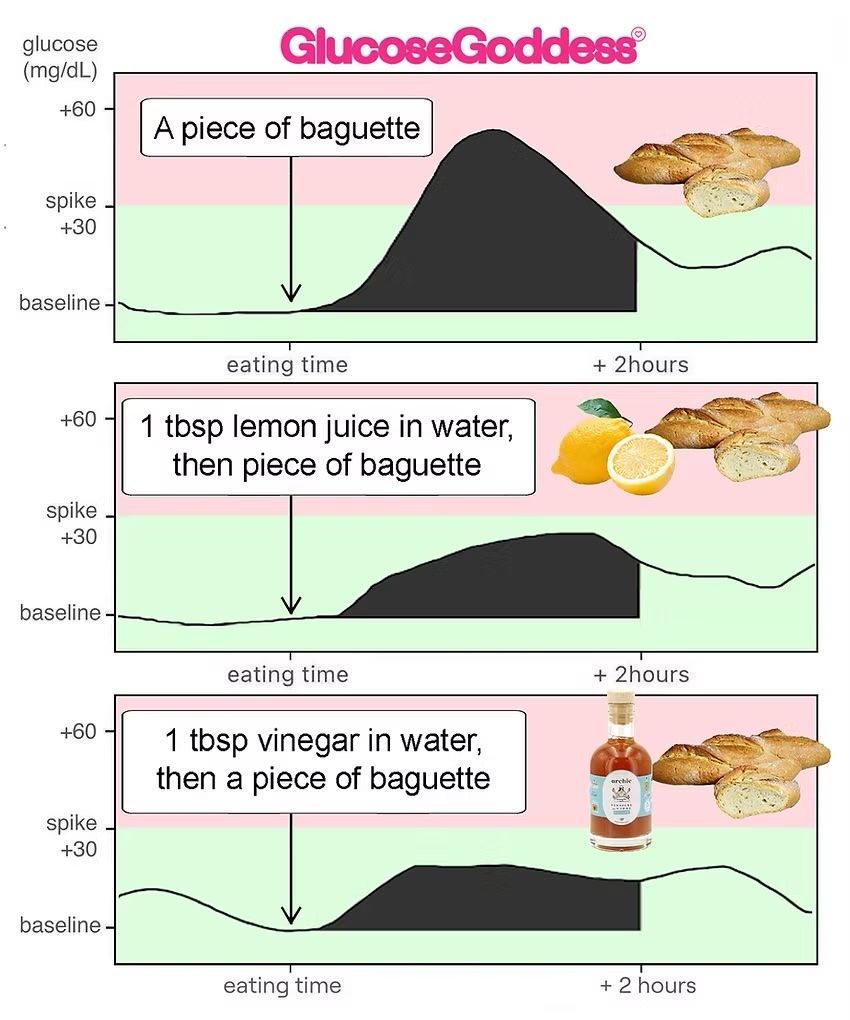
Image source: Jessie Inchauspé, “Vinegar—How to Use Vinegar to Steady Your Glucose: The Ultimate 2024 Guide,” glucosegoddess.com
Curcumin, the yellow component of the spice turmeric, has been known to lower blood sugar spikes when just a teaspoon of the spice is consumed. A 2023 review paper noted that the spice quadruples the amount of GLP-1 secreted.1
Cinnamon at a dose of less than a teaspoon daily has been shown to contribute to weight loss compared to placebo, too.2
In one crossover study, individuals were given either a placebo or a drink with various spices before eating 50 g of carbohydrate for breakfast. Both turmeric and cinnamon suppressed a glucose response without affecting insulin, suggesting to the researchers that they “may be important in lowering cardiometabolic risk.”3
Adding turmeric to your tea or coffee might promote only a minor GLP-1 secretion compared to an Ozempic surge, but a Golden Turmeric Coffee (recipe below) sounds so much more pleasurable.
Golden Turmeric Coffee
Ingredients
½ cup cream or your favorite substitute, such as almond milk
1 tsp ground turmeric
½ tsp cinnamon
Pinch of ginger and black pepper
1 cup brewed coffee
Dash of non-glucose-spiking sweetener, such as allulose or stevia (optional)
Method
1. Combine the cream and spices in a saucepan and heat until hot but not boiling.
2. Mix with coffee and sweetener and stir or froth with a mini immersion blender.
What do you think? Start a conversation over on the... WDDTY Community
1. CDC, “Adult Obesity Facts,” May 14, 2024, cdc.gov
2. CDC, “Childhood Obesity Facts,” Apr 2, 2024, cdc.gov
3. Office for Health Improvement and Disparities, “Obesity Profile: Statistical Commentary, November 2024,” gov.uk
4. Statistics Canada, “Overweight and Obese Adults, 2018,” June 25, 2019, www150.statcan.gc.ca
5. Fertil Steril, 2017; 107(4): 833–839
6. Int J Epidemiol, 2020; 49(4): 1353–1365
7. National Cancer Institute, “Obesity and Cancer,” Apr 5, 2022, cancer.gov
8. Chest, 2010; 137(3): 711–719
9. Hans van Leeuwen, “The Single Company Propping Up an Entire Economy,” Sept 18, 2023, afr.com
10. “Why the Anti-obesity Drug Market Could Grow to $100 Billion by 2030,” Oct 30, 2023, goldmansachs.com
11. “Obituary: Roger H Unger,” Nov 14, 2020, thelancet.com
12. Diabetes Investig, 2023; 14(7): 829–837
13. Diabetes Obes Metab, 2024; 26(3): 911–923
14. Int J Clin Pharm, 2024; 46(6): 1268–1280
15. Front Endocrinol (Lausanne), 2024: 15: 1382814
16. Nat Med, 2024; 30(7): 2049–2057
17. JAMA, 2024; doi: 10.1001/jama.2024.22284
18. J Investig Med High Impact Case Rep, 2021; doi: 10.1177/23247096211051919; Cureus, 2024; 16(1): e52564
19. JAMA, 2024; 332(1): 9–10; Diabetes Care, 2024; 47(10): 1718–1730
20. Canadian Frailty Network, “What Is Frailty?,” accessed Dec 4, 2024, cfn-nce.ca
21. Nutr Metab (Lond), 2016: 13: 92
22. Complement Ther Med, 2022: 70: 102852
23. PLoS One, 2023; 18(4): e0281150
24. Nutrients, 2024; 16(12): 1821
25. Food Funct, 2023; 14: 6914–6928
26. Adv Nutr, 2021; 12(6): 2540–2552
27. J Am Coll Nutr, 2007; 26(5): 434–44; Am J Clin Nutr, 1999; 69(6): 1135–43
Medical weight loss interventions1. Int J Obes, 1981; 5(4): 431–5
2. Lancet, 1977; 1(8024): 1221–2
3. Surg Obes Relat Dis, 2024; 20(5): 425–431
4. Lancet, 2024; 403(10433): 1235–1236
Splash in some vinegar
1. Foods, 2021; 10(2): 344
2. Nutrients, 2019; 11(8): 1943
Spice things up
1. Biochem Biophys Res Commun, 2013; 435(2): 165–70; Phytother Res, 2023; 37(4): 1703–1728
2. J Food Biochem, 2022; 46(8): e14166
3. J Funct Foods, 2017; 35: 574–583
JANFEB25
Great news! Discounts are available based on your cart total. Check the details below: