An exhaustive review has concluded that multiple vaccines—and not just the MMR—are the primary cause of the autism epidemic. Bryan Hubbard reports
Pharmaceuticals—either the painkillers women take during pregnancy or the vaccines we give our children—are the likeliest principal driver of the autism epidemic, which has seen rates explode by 32,000 percent in the US in the last 50 years, a major review has concluded.
Although science has done its utmost to put to bed the idea that the MMR (measles, mumps and rubella) vaccine causes autism, nobody has looked at the effect of multiple vaccines on the small child.
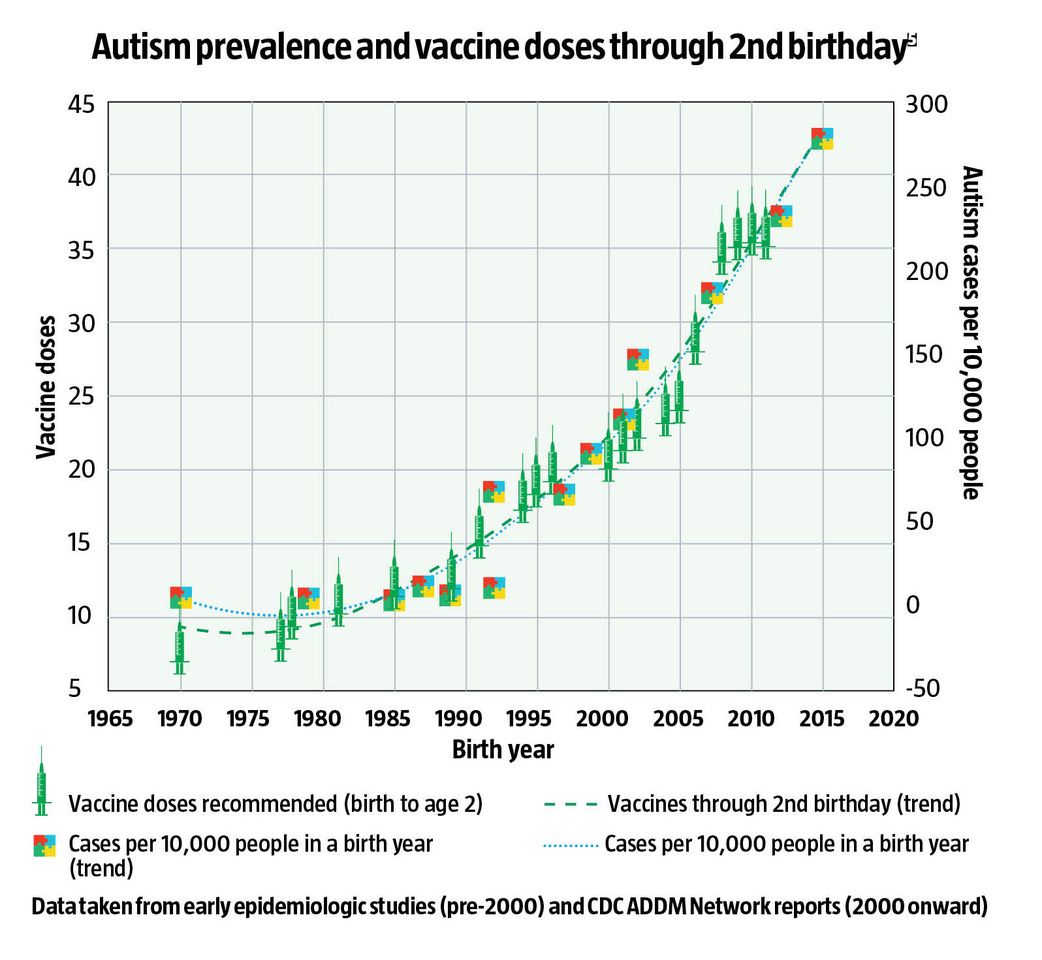
America has the world’s highest rate of autism, affecting one in 31 children (3.5 percent)—the average rate worldwide is one in 127, according to the World Health Organization—and the US also has the most aggressive vaccine schedule with 54 shots and boosters on offer. A one-year-old American child will have been given 25 vaccines.
Last autumn, the Trump administration called out acetaminophen—the painkiller marketed as Tylenol in the US and as paracetamol everywhere else—as the major driver of autism, or ASD (autism spectrum disorder). Up to half of all women take the painkiller during pregnancy to reduce fever, which can harm the developing fetus.
Although many factors are influencing the epidemic, the blame can primarily be laid at the door of multiple childhood vaccinations, especially in the first year or two of life, an exhaustive review by the McCullough Foundation has concluded.1 Other factors they suspect include parental age, premature delivery, sibling recurrence, gut/brain axis alterations, in utero drug exposure—such as to acetaminophen—and environmental toxins.
According to the review, the tipping point happened in 1986 when the US passed the National Childhood Vaccine Injury Act, which granted blanket liability protection to vaccine manufacturers if their products caused injury or even death. In that year, there were just 12 shots on the vaccine schedule.
Since then, there has been a steady increase in the number of vaccines given to children up to age five, and this has correlated to the rise in cases of autism. According to the Centers for Disease Control and Prevention (CDC), the US health monitoring agency, the incidence of autism has consistently risen every year, starting in the mid-1980s.
In 1970, just one in 10,000 American children was diagnosed with autism, but by 2000 this had risen to one in 150 children, and today one in 31 eight-year-old children is affected. Of these, 27 percent have profound autism, including loss of the ability to speak or interact with the world, and need lifetime care.
The increase is also reflected in the need for special education services. In 2000, just 15,556 American children were receiving teaching assistance, but by 2011 this had increased to 406,957 children, a 25-fold rise.
The reviewers, headed by Peter A. McCullough, a cardiologist who was vice chief of internal medicine at Baylor University, came to their conclusions after studying various sources. The main one was a review of 136 studies, 107 of which suggested a link between vaccines and ASD and other neurodevelopmental disorders (NDDs).
The researchers suspect the components in vaccines, such as thimerosal (ethyl mercury) and aluminum adjuvants, could be doing the damage by disrupting mitochondrial function, oxidative balance and neuroimmune signaling. These actions have been linked to neurodevelopmental injury and regression in susceptible children.
They also looked at case reports, including one of a 19-month-old girl who developed ASD symptoms after receiving multiple vaccines, with mitochondrial dysfunction confirmed by muscle biopsy. And they reviewed 12 studies that compared the health of vaccinated and unvaccinated children and found that the unvaccinated had better health, including fewer chronic health problems and NDDs such as ASD.
Conversely, large studies have found no link between vaccination and autism, and these have frequently been cited as a response to the Andrew Wakefield study of 1998, which examined just eight children who had developed gut abnormalities soon after being given the MMR jab. But few studies have looked at the cumulative effect of many vaccines, the McCullough researchers say.
“As a result, a small fraction of the total vaccine exposure experienced by children has ever been systematically evaluated for associations with ASD or other NDDs,” their report states.
Interestingly, ASD rates fell in the years following Wakefield’s study as takeup of the MMR fell to 80 percent in countries such as the UK and northern Europe. It then slowly climbed again as people were reassured that the vaccine was safe to give to their children.
Critics argue that McCullough has formed and peddled “false” information about vaccines for years. By 2025, the American Board of Internal Medicine had revoked his two board certificates, claiming he had spread “misinformation” about the Covid virus and the mRNA vaccines.
To make matters worse for his critics, McCullough has been joined in his review by Andrew Wakefield, the UK gastroenterologist whom Wikipedia describes as a fraudster and anti-vaccine activist. Wakefield lost his medical license after the UK General Medical Council stated he had committed fraud and malpractice when he conducted the small study published in The Lancet in 1998, a paper that was retracted 12 years later.
According to his accusers, Wakefield also failed to disclose a financial incentive to find a link between the vaccine, novel gastrointestinal problems and autism. Despite this supposed inducement, Wakefield concluded in the study that it was too small to establish a causal link between the vaccine and autism.2 And The Lancet later determined he and his colleagues had committed no ethical violations.3
Controversy about the study erupted six years after its publication, and the McCullough review gives some context to it. For one, Wakefield was not the first to suspect an association between the MMR vaccine, gut problems and autism. In 1996, two years before his paper was published, American clinical immunologist H.H. Fudenberg published a study claiming 15 children with autism developed symptoms within a week after being vaccinated.4
The McCullough review also suggests the reasons for the time lag between the Wakefield paper’s publication and the kickback against it, which started six years later. In 2002, the US Court of Federal Claims had established a process—known as the Omnibus Autism Proceeding—for evaluating thousands of parental petitions alleging that multiple vaccines administered in early childhood had caused their children to regress into autism.
Two years later, the Sunday Times, a UK newspaper, ran a series of articles against Wakefield alleging fraud, malpractice and financial inducements.
“The timing suggests that this opening salvo against Wakefield was part of the broader campaign to discredit the claims of petitioners in the Omnibus Autism Proceeding. In 2009 the US Court of Federal Claims ruled that no link between vaccines (and vaccine preservatives and adjuvants) had been proven, and therefore dismissed the claims of the over 5,000 petitioners,” the McCullough review reports.
However, the court determined that the case of one petitioner, Dr John S. Poling, a neurologist at Johns Hopkins Hospital, was valid. His 19-month-old daughter had received several vaccines at once, and this had caused her regression into autism, it ruled.
The court’s ruling for the rest of the petitioners ignored the observations of parents, who saw their children regress into autistic behaviors soon after receiving multiple vaccinations. Perversely, the ruling also went against the clinical findings of the vaccine manufacturers themselves.
The manufacturers have noted in package inserts that the MMR’s side effects may include seizures, encephalomyelitis (brain inflammation), transverse myelitis (brain and spinal cord inflammation), fainting, polyneuropathy (nerve malfunction), ataxia (lack of voluntary muscle coordination, speech changes, abnormal eye movements), Guillain-Barré syndrome and progressive neurological disorder.
Health agencies say the rise in autism is mainly the result of greater awareness and better monitoring, but it’s hard to accept that the 32,000 percent increase in cases is entirely the result of these factors, although they no doubt account for some of them.
Denying any link to vaccinations is just bad science, the McCullough researchers argue. Studies that have failed to find an association have been limited by the difficulty in finding unvaccinated children to act as controls—a phenomenon peculiar to countries such as the US, where vaccination is practically compulsory. There’s also a failure to recognize that autism is a spectrum disorder with many characteristics, they point out, and so many cases may have gone unrecorded.
The waters are also muddied by the likelihood that there are many causes of autism. Genetics, environmental pollutants such as PVC pipes leaching phthalates into drinking water and glyphosate in food, and antidepressants taken during pregnancy could all be in the frame.
But as with research into lung cancer, which was able to establish smoking as a principal factor, if not the only one, so the causes of autism should be narrowed down to a temporal connection: Autistic behaviors followed quickly after exposure, such as to vaccination. Ultimately, McCullough hasn’t established beyond doubt that multiple vaccinations are causing autism, but there are numerous correlations that point only one way.
There are also many people, including commercial, ideological and political groups, who deliberately discredit and suppress any suggestion of a link. As vaccine manufacturers are off the hook, it’s down to governments to pick up the tab and pay out the vast compensation that would be due if vaccines were proven to have caused an autism epidemic.
What do you think? Start a conversation over on the... WDDTY Community

Great news! Discounts are available based on your cart total. Check the details below: