The Covid epidemic and its treatment have put vaccination back in the limelight. They’ve also created new labels for people who ask questions: “anti-vaxxer,” “vaccine denier” or just plain “conspiracy theorist.” However, in the 31 years that WDDTY has been publishing and covering vaccination, we’ve discovered that all vaccines carry a sliding scale of risk and benefit. What’s beneficial for one person may be detrimental to another. To make an informed decision about vaccines, asking questions is essential and the right of every person, particularly every parent.
In our view, there are three main questions to ask of every vaccine before submitting to it:
In Vaccine Watch, our new series, we do the asking for you.
Pertussis, or whooping cough, is a respiratory infection caused by the Bordetella pertussis bacteria first described in the seventeenth century. The disease results when the bacteria attach to cells of the respiratory tract, produce toxins that paralyze the cilia, the tiny hairs lining the tract, and cause inflammation, interfering with the ability to clear lung secretions.
Usually, the disease course begins with a seven- to 10-day incubation period, followed by cold-like symptoms of runny nose, sneezing, low-grade fever and occasional coughing. The cough gradually worsens after one to two weeks, when the second phase distinguished by the “whooping” cough begins.
The disease got its name from the characteristic high-pitched “whoop” noise that sufferers of more severe infections make as they try to catch their breath during frequent bouts of coughing. Children and young infants, especially, might become cyanotic (having bluish skin) just before a spasm of coughs and appear ill and distressed during the attacks. They may vomit after a bout of coughing, but often they appear to be in good health between bouts. Attacks, which may strike at night, gradually fade in frequency and are usually gone within two to three weeks, but sometimes persist for two to three months.
Prior to World War II, most people would have experienced whooping cough by adulthood, though many with mild or no symptoms would not even have known they had it.1 Although infants accounted for the most deaths at that time (as now, though it’s significantly lessened), a 1937 report from the Canadian Medical Association Journal observed that, “for a suckling infant, to have whooping cough is most unusual,” supporting the fact that mothers confer some immunity in breastmilk that protects their vulnerable infants.2
As frightening as the cough may sound, particularly in infants, and though infections were more common and more lethal historically, today death from pertussis in the developed world is exceedingly rare and most often caused by secondary pneumonia infection.3 The US Centers for Disease Control and Prevention (CDC) reported seven deaths (four of them in infants) among 18,617 cases in 2019,4 and five deaths (three of infants) among 15,609 cases in 2018.5
The story is the same in the UK, where deaths from pertussis infection started to fall dramatically even before vaccination was rolled out nationally in 1957, and today they are quite rare, as the table on page 38 illustrates. Curiously, as routine childhood vaccination plummeted in 2020,6 the UK experienced a tandem drop in cases of pertussis and zero deaths for the first time in its history.7 In the developing world, pertussis is still a high-mortality disease, particularly in infants, largely because of other factors including malnutrition, poor sanitation and poor care.
Pneumonia is the most common complication in all age groups, and the leading cause of pertussis mortality. Seizures and encephalopathy (a blanket term for altered brain function) are rare and generally occur only among very young infants, according to the CDC.8 Most hospitalizations occur in infants under six months old, and most of them survive.9
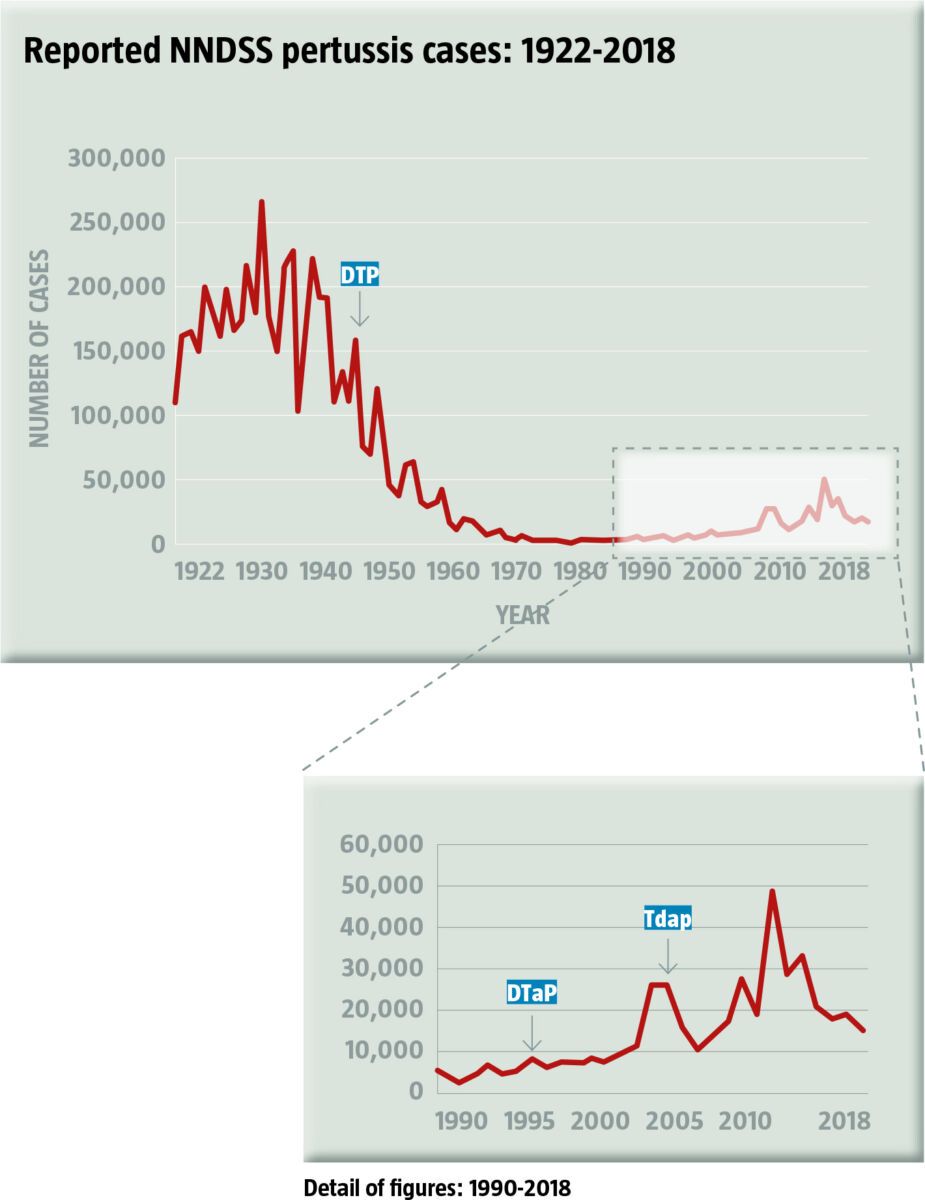
Although it has a low mortality rate, pertussis has experienced a resurgence in recent years, beginning its ascent in the 1980s, then climbing after a change to the acellular DTaP vaccine in the 1990s. The rise prompted the US National Institutes for Health to place pertussis on the list of emerging pathogens in 2015.
The decline in pertussis, as with most infectious diseases, had more to do with infrastructure and engineering offering potable water and sewage systems, along with increased hygiene, more than any medical interventions including vaccines, and even antibiotics, as the graph on the left illustrates.
Graph 1 shows that pertussis rates had begun falling before the introduction of the first DTP vaccine. The rate then began to increase again after the introduction of the acellular DTaP vaccine in the 1990s (inset).
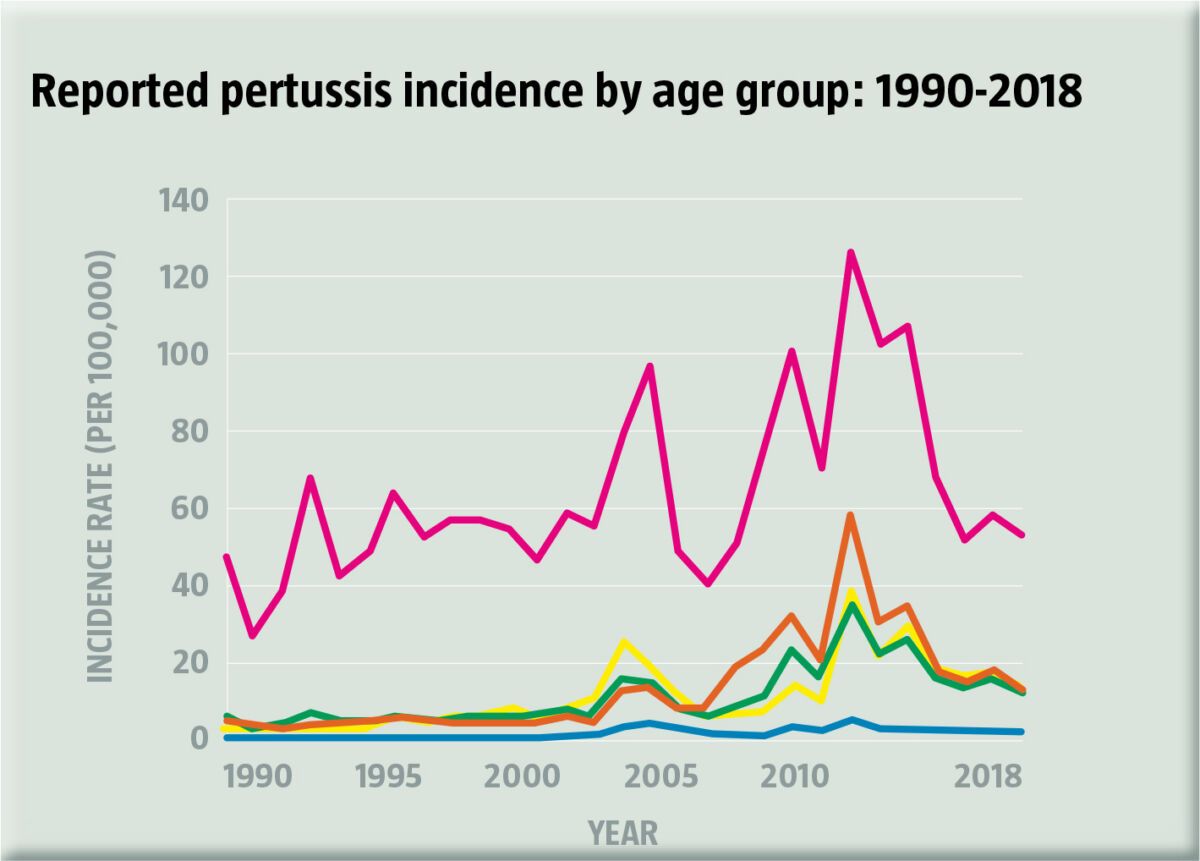
Graph 2 (below)shows that since the introduction of the DTaP vaccine and Tdap booster, which wane in effectiveness over time, cases have begun to increase notably in older children and adults, along with the infants most threatened by pertussis.
The short answer is: we don’t know. In the 1940s, a vaccine for diphtheria, tetanus and pertussis (whooping cough)—the DPT or DTP—was introduced in the US. In the UK, in 1957, the pertussis vaccine was a crude preparation of heat-treated whole-cell Pertussis bacteria and its toxins, rinsed in formaldehyde, a known carcinogen, with neurotoxic aluminum added as an “adjuvant” to stimulate an immune system response, and thimerosal mercury as a preservative.
The only “testing” of the original whooping cough vaccine was conducted by the UK’s Medical Research Council, which rolled it out with only prior experimental evidence on 50,000 children at least 14 months old. The US never conducted tests of its
own but rather relied on those conducted in the 1950s in Britain.
It was clear by the 1970s that outbreaks of pertussis were occurring among the fully vaccinated. In one study of whooping cough cases in 1974–5 and 1978–9, and in 1974 in the US and Canada, one-third to one-half of all victims had been fully vaccinated. Furthermore, in a study of 160 cases of infants contracting whooping cough, two-thirds were exposed to the disease by their fully vaccinated siblings.10
During a nationwide epidemic of whooping cough in 1993, a group of researchers from Cincinnati Children’s Hospital, in Cincinnati, Ohio, found that the epidemic mainly occurred among children who had completed the full course of DPT vaccines.11
During that year, 6,335 cases of whooping cough were reported, the most in 26 years. Of those, 352 cases occurred in Cincinnati, an increase of 250 percent over the previous year. Among those affected, three-quarters had received four or five doses of the DPT vaccine, and 82 percent had received up to three doses, considered adequate to provide full protection.
Since many of the children who contracted the disease were between 19 months and six years old, scientists began to agree that the whole-cell pertussis vaccine did not offer long-term protection.
Similarly, in Finland, a study found that in a population with a 98 percent immunization rate, whooping cough infections remained common. Although the study found that whooping cough was common in children younger than school age, the incidence was higher in school-age children and adults. This suggested that protection from the vaccine decreases over time.12
Research from Sweden (where whooping cough is a major problem, with epidemics peaking every year in the nation’s children) and Italy also concluded that the whole-cell vaccine was effective in just 48 percent and 36 percent of cases, respectively.13
There is no evidence that the vaccine prevents pertussis. In fact, there is evidence of the opposite—with studies finding two-thirds of children with the disease already fully vaccinated and multiple instances of vaccinated children passing the disease to their unvaccinated siblings.
“Precise information about the efficacy and safety of this vaccine is lacking, because existing provisions, national and international, for epidemiological surveillance and evaluation are inadequate,” wrote Professor Gordon Stewart, formerly of the Department of Community Medicine at the University of Glasgow, in the Lancet medical journal in 1977. “No protection by vaccination is demonstrable in infants.”10
According the seminal book, DPT: A Shot in the Dark (Avery Publishing Group, 1991), written by Barbara Loe Fisher, the mother of a baby injured by the DPT and founder of the National Vaccine Information Center in the US, and medical historian Harris L. Coulter, 42 babies who had convulsions within 28 days of having been given the whole-cell vaccine were omitted from the data pool of the early drug trials, and the shot was assumed to be safe even though about one in every 1,000 babies had a serious and potentially brain-damaging adverse effect.
The trials were designed to demonstrate efficacy, not safety, however, and British and US health authorities have used them as evidence that the vaccine is safe to give to babies as young as six weeks of age, say Coulter and Fisher. This means the drug was never assessed for safety in newborns at the dosage given to older children. Dosages were the same from tiny neonates to toddlers many times their weight.
By 1960, the medical literature included case reports of children permanently brain damaged by pertussis vaccination,14 and the medical community knew that whole-cell pertussis vaccine could cause convulsions and other serious problems.15
The link between the pertussis component in the DPT vaccine and encephalopathy was first raised in 1933. Encephalitis is an inflammation of the brain, causing a bulging and red fontanel (the “soft spot” in the skull where the bones haven’t fused yet) in infants.
The symptom of high-pitched crying can be a red flag for the condition. According to author Fisher, “this kind of crying, a thin, eerie, wailing sound quite different from the child’s normal cry, [very much resembles] the so-called cri encephalique [encephalitic scream] found in some cases of encephalitis.”
Hypotonic-hyporesponsive episodes (HHEs), characterized by a sudden onset of reduced muscle tone (limpness, floppiness), decreased responsiveness to verbal or other stimuli and change in skin color (pallor or cyanosis, looking very pale or bluish) that occur within a brief period after vaccination were first described in 1961 in association with the whole-cell pertussis vaccine, administered on its own or combined with diphtheria and tetanus in the DTP.16
HHEs were seen primarily following a first dose of the vaccine, with rates reported as high as 145 per 100,000 doses. While researchers have concluded recently that these frightening episodes of infant unresponsiveness are “benign,” they also acknowledge that they don’t understand what is happening in these babies.
“Many hypotheses have been postulated about pathogenesis of HHE; activation of inflammatory pathway could play a role, eventually eliciting autonomous nervous system activity. Recent works show how autonomous nervous system can be influenced by inflammation and vice versa,” wrote researchers from Regina Margherita Children’s Hospital in Turin, Italy.17
The previously cited 1977 Lancet article by Gordon Stewart at the University of Glasgow described 160 adverse events known to him, 79 with a “strong” relationship to the vaccine, including 14 of which were “transient but characteristic of a syndrome of shock and cerebral disturbance,” and in the remaining 65 cases, the vaccine was followed by convulsions, abnormal muscle movements and “severe mental defect.”10
“It seems likely that most adverse reactions are unreported and that many are overlooked,” and are “more common and more serious than generally recognized,” Stewart added.
A 1981 FDA study by researchers at the University of California, Los Angeles, reported that one in 875 babies suffered convulsions or a shock reaction to DTP shots, and some of the babies suffered serious neurological damage and low IQs as a result.18 The same year, the British National Childhood Encephalopathy Study (NCES) estimated that one in 110,000 babies who got a DTP shot developed a serious neurological problem within seven days, and chronic neurological dysfunction was linked to one in 310,000 DTP shots.19
Ten years later, children in that study were still more likely to suffer from “educational, behavioural, neurological, or physical dysfunction” or to have died compared to other children who had not had an acute reaction shortly after vaccination.20
In the US, vaccine reactions are reported to the Vaccine Adverse Events Reporting System (VAERS), a passive surveillance system established in 1986. A search of the database on November 12, 2021, yielded 197,354 reports associated with diphtheria, tetanus and pertussis-containing vaccines (DTP, DTaP, Tdap, Td and combination vaccines) including 3,280 deaths, 4,033 life-threatening episodes, 23,443 hospitalizations (including 1,076 cases of prolonged hospitalization) and 3,599 cases of permanent disability.
While the VAERS database stresses that adverse events reported after vaccination are not necessarily caused by the vaccines, it is well-established that the VAERS system only captures a small fraction of the adverse events that should be reported following vaccination.
A 2009 Harvard Pilgrim study examining medical records found that only 1 percent of adverse events that ought to have been reported to the government database were in fact reported. If 99 percent of reactions are not reported, the true figures of reactions since 1986 would be closer to 19,735,400.2
Nicholas Scott Catone, the 20-month-old son of retired American mixed martial artist fighter Nick Catone, died in his sleep 17 days after a DTaP injection that made him ill in the days following. His parents drew huge public attention to the lethal dangers of the shot on social media. Nicholas had been a perfectly healthy toddler before the vaccine, and his family told the public that the coroner’s investigation into their son’s death was a sloppy sham (www.nickcatone.com).
Baby Nash Grim was a healthy, happy infant who was on target for all of his developmental milestones. On January 22, 2021, he went to a pediatrician check-up where the doctor declared, “He is perfect,” and gave him a DTaP injection.
On February 4, Nash woke from a nap at his daycare with purple lips and limp arms, struggling to breathe. He was intubated and flown to Children’s Hospital in Omaha, where he was diagnosed with a form of paralyzing myelitis that has been linked to the DTaP; his mother is raising funds for Nash to receive stem cell treatment therapy (circleofmamas.com/health-news/one-dtap-shot-paralyzed-baby-nash-from-the-neck-down/).
In 1982, a documentary called Vaccine Roulette aired on national television in the US, highlighting the plight of parents whose children were permanently brain damaged by the vaccine and the intransigence of public health officials.
A year later, a UCLA study of 145 infants who had died of sudden infant death syndrome (SIDS) found that 53 of them had received a DPT shot and 23 had died within 28 days of the vaccine, 12 of them within 24 hours, pointing to a death rate significantly above baseline for vaccinated infants.21
In 1986, with DPT vaccine makers including Wyeth pharmaceuticals—now Pfizer—swimming in lawsuits, the pharmaceutical industry persuaded the government to pass the National Childhood Vaccine Injury Act, which shielded vaccine makers from liability for vaccines and made taxpayers fund a government-run payout scheme for damages. It also removed any financial consequences—and incentive—for vaccine producers to make their vaccines truly safe.
By the early 1990s, the DPT vaccine accounted for most adverse reactions reported to the US Vaccine Adverse Event Reporting System (VAERS), set up by the government to identify vaccine side-effects. From January to August 1991, there were 3,447 reports of DPT reactions in that period—66 percent of all reported events.
The Institute of Medicine (IOM) at the National Academy of Science, a group of 11 leading pediatric figures in the US, spent 20 months reviewing hundreds of scientific papers at that time. They concluded that the whooping cough vaccine could cause encephalopathy and brain damage in previously healthy babies.
Their final statements were weak, but it was the first time that an American medical organization stated on the record that the pertussis vaccine does damage some children.22 Based on a review of 10-year follow-up data from the UK National Childhood Encephalopathy Study (NCES), the IOM said the vaccine could also trigger an acute neurological illness in children with underlying brain or metabolic abnormalities.
Researchers were also concerned that children could develop chronic brain dysfunction or even die if they developed an acute neurological illness within seven days of DTP vaccination. The IOM in 1991 estimated that there have been up to 10.5 excess cases of the condition per million vaccinations.
Although the committee said there was not enough evidence to conclude a relationship with various other disorders, it emphasized that they were not to be ruled out. These include chronic neurologic damage, Guillain-Barré syndrome (a disease characterized by paralysis of the limbs), juvenile diabetes, learning disabilities, attention deficit disorder, infantile spasms and SIDS. There was also concern that premature infants given the vaccine might suffer from episodes of apnea (that is, they stop breathing).23
The suggested link between the vaccine and SIDS is borne out by the work of Dr Archie Kalokerinos and Glenn Dettman studying aboriginal children in Australia. In the early 1970s, the researchers were puzzled when the death rate of aboriginal children skyrocketed. Then they realized that the rise in the death rates coincided with intensified efforts to immunize these children, many of whom were ill or had serious vitamin deficiencies when they received the shots.24
An American doctor, who prefers to remain anonymous, treated a boy of four. He said the boy suddenly started to display characteristics of autism within days of receiving the fourth in a series of childhood vaccines, which included DPT, Sabin polio and hepatitis B. He had suffered fevers after the first three vaccinations, but nothing worse.
Until the fourth vaccine, his parents said he was very bright and affectionate and had a vocabulary of 25 words. But after the fourth, he suffered vomiting, fever, lethargy and excessive sleepiness. After three days, he had an episode of inconsolable, high-pitched screaming (symptoms typical of the cri encephalique—see main text). Immediately after this episode, he stopped talking, and there was a rapid change in his sociability.
He also displayed repetitive behavior and hand flapping, all characteristics of autism. Medical tests revealed brain inflammation, although no neurologist would confirm the parents’ suspicion that the vaccine was the cause.
By the mid-1990s, Western countries halted the deadly DPT and rolled out the “safer” and “purified” new attenuated (killed first with hydrogen peroxide), rather than whole-cell, DTaP (diphtheria, tetanus, attenuated pertussis) vaccine, licensed with brand names Daptacel, Infanrix. A lower-dose Tdap booster shot was marketed with brand names Adacel and Boostrix, as well.
In Sweden, where it was tested on a group of infants, the full three-dose course of the vaccine worked less than three-quarters of the time (71 percent efficacy), and it was only 55 percent effective after two doses.25 A scientist working on the vaccine at the Mayo Clinic in Minnesota explained that they didn’t really understand how much pertussin toxin is necessary to protect children; even those with high levels of antibodies in their blood seem to go on and get whooping cough.26
A later Swedish study, which monitored over 80,000 children for three years, found that among three versions of the acellular vaccine, two were far less effective than the whole-cell vaccine.27
Just like vaccines against Covid-19, pertussis vaccines are “non-sterilizing” or “leaky” vaccines because they do not actually prevent infection and transmission; they are only designed to reduce symptoms of illness. Asymptomatic infection is common in vaccinated children,28 and there are scientific reports of vaccinated individuals spreading pertussis disease to others. One study of an outbreak in Australia discovered that vaccinated 2- and 3-year-olds were the “most important source of pertussis in infants 6 months and younger”—the group most vulnerable to infections.29
“In pre-vaccine era, natural immunity for pertussis was near life-long up until the 1950s, but has since been considerably shortened down to 20 years by 1995, and to 3.5–12 years by 2002,” writes Lawren Pulse of the World Health Collective, citing a 2012 study that concluded flatly: “Our data suggests that the current schedule of acellular pertussis vaccine doses is insufficient to prevent outbreaks of pertussis.”30
The US researchers noted a “markedly increased rate of disease from ages 8–12 years, proportionate to the interval since the last scheduled vaccine.”
Whereas the researchers merely recommended more boosters to counter the original vaccine failure, as Pulse notes, even with five doses of DTaP on the schedule, pertussis vaccination has very limited durability. Researchers have observed that the DTaP vaccine effectiveness wanes progressively,31 with the odds of being infected with pertussis increasing at a rate of 42 percent per year.32
A Tdap booster was introduced for adolescents to try to prolong protection conferred by five childhood DTaP shots, but outbreaks of pertussis still occurred in those vaccinated six times, with the Tdap offering only moderate protection against pertussis during the first year after injection and then waning rapidly.33
The drop in vaccine effectiveness has repercussions for who is at risk for the disease. In 1982, children under 14 made up nearly 96 percent of pertussis cases in the UK, and only 0.14 percent of cases occurred in the elderly over age 65. By 2020 (the last year for which there is complete laboratory-confirmed data), those over 15 made up nearly a two-thirds majority (62 percent) of cases, and those over 65 accounted for more than 7 percent of pertussis cases.7
As most of the population is vaccinated against the disease, this age shift is indicative of another unintended consequence of mass vaccination with a vaccine that offers fading protection. This, even though the vaccine is primarily aimed to protect newborn children—usually the only ones whose lives are threatened by an otherwise relatively benign disease.10
According to the large Swedish study mentioned above, acellular vaccines appeared to carry the same side-effects as the whole-cell vaccine, including convulsions and HHEs, but at a lower incidence rate.1
The package inserts for DTaP vaccines (Daptacel and Infanrix, Section 6.2 Post-Marketing Experience) report a laundry list of adverse events including: lymphadenopathy (swollen lymph nodes) , thrombocytopenia (low blood platelet count), cyanosis (skin turning blue from lack of oxygen in the blood), nausea, diarrhea, injection site nodule/mass, extensive swelling of injected limb (including swelling that involves adjacent joints), hypersensitivity, allergic reactions, angioedema (swelling of tissue under the skin), erythema (reddening of skin), pruritus (itching), urticaria (hives) and other types of rash, hypotonia (low muscle tone), headache, ear pain, apnea, fatigue, somnolence (sleepiness), syncope (fainting) and SIDS.2
Package inserts for Tdap vaccine boosters (Adacel and Boostrix) include: lymphadenitis (infected lymph node), lymphadenopathy, allergic reactions, including anaphylactic and anaphylactoid reactions, myocarditis (heart inflammation), myositis (inflamed muscles), muscle spasms, arthralgia (joint pain), back pain, myalgia (muscle pain), large injection site reactions (>50 mm), extensive limb swelling from the injection site beyond one or both joints, injection site induration, injection site inflammation, injection site nodule/mass, injection site pruritus, injection site bruising, sterile abscess, hypersensitivity, angioedema, edema, rash (exanthem, Henoch-Schönlein purpura, urticaria), hypotension, convulsions (with and without fever), encephalitis, facial palsy, loss of consciousness, paresthesia (burning or prickling sensation), hypoesthesia (numbness), Guillain-Barré syndrome, brachial neuritis, syncope and myelitis.3
Case reports in the medical literature describe infants having seizures4 and hypotonic-hyporesponsive episodes,5 children developing welts6 and adults developing autoimmune conditions after DTaP shots.7
Main article
|
References |
|
|
1 |
Br Med J (Clin Res Ed), 1986; 292(6518): 441–4 |
|
2 |
Can Med Assoc J, 1937; 37(3): 268–72 |
|
3 |
CDC, “The Epidemiology and Prevention of Vaccine-Preventable Diseases” www.cdc.gov |
|
4 |
CDC, “2019 Final Pertussis Surveillance Report” www.cdc.gov |
|
5 |
CDC, “2018 Final Pertussis Surveillance Report.” www.cdc.gov |
|
6 |
BMJ, 2020; 369 |
|
7 |
Public Health England, “Laboratory confirmed cases of pertussis in England. Annual report for 2020 supplementary data tables” |
|
8 |
CDC, “Manual for the Surveillance of Vaccine-Preventable Diseases. Chapter 10: Pertussis.” www.cdc.gov |
|
9 |
CDC, “NCHS Data on Pertussis Hospitalizations in Young Children.” |
|
10 |
Lancet, 1977; i: 234–7 |
|
11 |
N Engl J of Med, 1994; 331: 16–21 |
|
12 |
JAMA, 1998; 280(7): 635–7 |
|
13 |
JAMA, 1995; 274(6): 446–7 |
|
14 |
Br Med J, 1958; 2(5087): 24–7 |
|
15 |
Br Med J, 1960; 2(5207): 1184–1186 |
|
16 |
Pediatr Infect Dis J, 2021; 40(12): 1122–6 |
|
17 |
Hum Vaccin Immunother, 2017; 13(6): 1375–8 |
|
18 |
Pediatrics, 1981; 68(5): 650–60 |
|
19 |
Br Med J (Clin Res Ed), 1981; 282(6276): 1595–9 |
|
20 |
BMJ, 1993; 307(6913): 1171–6 |
|
21 |
Pediatr Infect Dis, 1983; 2(1): 7–11 |
|
22 |
IOM Vaccine Safety Committee,. Adverse Effects of Pertussis and Rubella Vaccines. Chapter 4: Encephalopathy (pp. 86-88), 1991; IOM Committee to Study New Research on Vaccines. DPT Vaccine and Chronic Nervous System Dysfunction: A New Analysis. Executive Summary (pp. 1-2), 1994 |
|
23 |
J Pediatr, 1997; 130(5): 746–51 |
|
24 |
Second Thoughts On Disease: A Controversy and Bechamp Revisited. 1977. www.whale.to/w/kal.htm |
|
25 |
N Engl J Med, 1995; 333: 1045–50 |
|
26 |
Lancet, 1996; 347: 209–10 |
|
27 |
Lancet, 1997; 350(9091): 1569–77 |
|
28 |
J Infect Dis, 1994; 170(4): 873–7; Scand J Infect Dis, 2014; 46(4): 280–7 |
|
29 |
Commun Dis Intell Q Rep, 2014; 38(3): E195–200 |
|
30 |
Clin Infect Dis, 2012; 54(12): 1730–5 |
|
31 |
JAMA, 2012; 308(20): 2126–32 |
|
32 |
N Engl J Med, 2012; 367(11): 1012–9 |
|
33 |
Pediatrics, 2016; 137(3): e20153326 |
Official reports of reactions
|
1 |
Merck Manual Professional Version, 2020. “Diphtheria-Tetanus-Pertussis Vaccine.” www.merckmanuals.com |
|
2 |
US Agency for Healthcare Research and Quality. “Electronic Support for Public Health – Vaccine Adverse Event Reporting System (ESP:VAERS).” digital.ahrq.gov |
How safe is the DTaP vaccine?
|
1 |
Lancet, 1997; 350(9091): 1569–77 |
|
2 |
FDA, 2019, “Daptacel Package Insert”; “Infanrix Package Insert.” www.fda.gov |
|
3 |
FDA, 2019, “Adacel Package Insert”; “Boostrix Package Insert.”www.fda.gov |
|
4 |
North Clin Istanb, 2020; 7(3): 302–4 |
|
5 |
Hum Vaccin Immunother, 2017; 13(6): 1375–8 |
|
6 |
Pediatr Dermatol, 2018; 35(5): e262–4 |
|
7 |
SAGE Open Med Case Rep, 2018; 6: 2050313X17750335; J Med Case Rep, 2018; 12(1): 356 |
What do you think? Start a conversation over on the... WDDTY Community

Great news! Discounts are available based on your cart total. Check the details below: