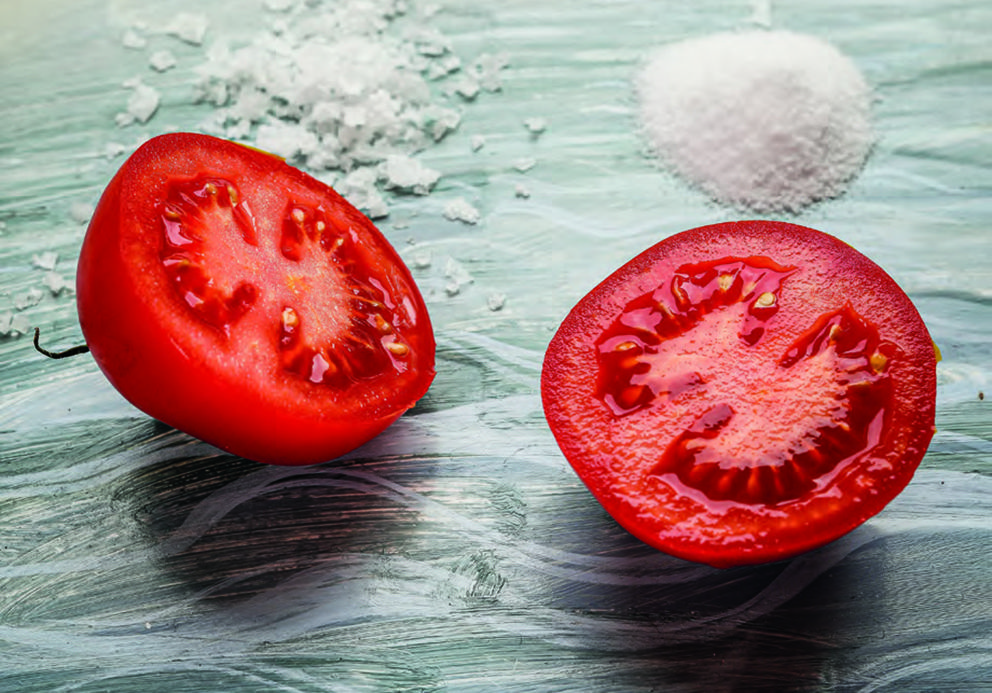
Salt-obsessed chef James Strawbridge shares his top tips for choosing a healthy salt as well as some of his favorite gut-friendly fermented food recipes
Salt once enjoyed a highly prized status at our tables and was used in many ways: as a currency, as a ritual gift, to preserve food over winter and as a key ingredient within the ceremony of cooking. Yet today salt is vilified as a risk to public health and is driven out of our diet.
But all salt is not created equal. There is a huge difference between a local artisan sea salt and chemically processed table salt or PDV (pure dried vacuum) salt. In their natural, unrefined form, sea salts have the perfect balance of minerals for us to thrive, corresponding proportionally to the minerals found in our bodies and so matching our own bodies’ requirements.
Most salt production around the world today is heavily standardized on a large scale. The process of making table salt removes almost all other minerals, leaving a product that’s at least 99.8 percent sodium chloride. Compare this to a good artisan sea salt, in which the percentage of sodium chloride could be as low as 85 percent and be balanced with more than 60 beneficial sea minerals deliberately captured and laminated onto the crystals for more flavor and better balance (see “The structure of salt” below). To me, there’s no competition when deciding which salt to cook with.
Table salt, a refined salt that can come from either sea salt or rock salt, has had most of the moisture taken out of it. This makes it very thirsty, or hygroscopic, so the salt wants to attract water and, if left alone, would clump together, so anti-caking agents are added. These aluminum-based compounds have been shown to be bad for your health.
Table salt is only good for gritting pathways or making salt dough for children to play with. To put it bluntly, table salt is not for eating. I do not own any table salt and don’t use it to cook with ever. I prefer the flavor and depth from good salt rather than a one-dimensional chemical tang from table salt.
Crucially, when you use mineral-rich, tasty salts, you need to add far less in your cooking than if you use horrible-tasting table salt. Due to the mineral notes you can taste when it’s dissolved on your palate, even with less salt, you can deliver more flavor.
This is what I explain to the many food manufacturers I work with in the UK that are seeking to reduce salt in their products and menus. It’s the percentage of sodium in the incumbent salt that they use for their production (normally a cheap table salt) that is the problem rather than just how much salt is in their recipes.
Some 75 percent of our salt intake comes from prepared or processed foods. So, cook from scratch for better-seasoned food that you can control.
One of my favorite ways to use salt is in lacto-ferments. By controlling the exact percentage of salt added to food, you can delicately balance the growth of beneficial bacteria while simultaneously preventing the growth of unwanted bacteria.
Lacto-fermentation transforms vegetables and fruit with tangy, fizzing, gut-friendly bacteria. The sour pickles extend the shelf life and are unique in the way they blend salty and sour flavors.
The beneficial bacteria in a ferment consume glucose from the vegetables and fruit; they then convert this into lactic acid. As part of this partial breakdown of plant sugars, we get an acidic byproduct that creates delicious flavors. Salt is instrumental in this process, and the end product retains a well-seasoned balance—enhanced further by the symbiotic sour taste.
Osmosis is another natural process key to sour pickling. Rubbing salt over vegetables and fruit draws water out and salt in until the amount of salt dissolved is equal inside and out. The liquid produced is often enough (once the ingredients are packed into a jar) to create the anaerobic environment beloved of lacto-bacteria—so don’t throw it away!
A warm environment helps speed up the fermentation process of seven to 10 days. Lower temperatures lead to a slower rate of fermentation, creating deeper, more full-bodied ferment flavors. The acidic, salty and oxygen-free environment inhibits unwanted bacteria and molds, so you should be able to store the sealed ferments at room temperature for several months.
Here are some simple recipes to try.
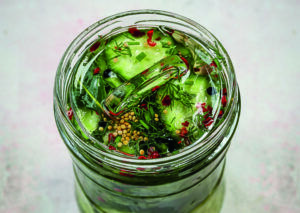
To me, the juicy crunch, sour lactic tang, gentle anise, chili heat and garlic in this recipe is poetry. The bay leaves help provide extra flavor but also keep the cucumber texture crunchier. Try serving with burgers, cold meats or salads.
Makes a 1-L or 1¾-pint jar
Ingredients
2 cucumbers, crinkle cut
2 garlic cloves, peeled
4 bay leaves
1 tsp chopped dill
1 tsp yellow mustard seeds
1 tsp black peppercorns
½ tsp dried chili flakes
3 percent weight fine sea salt flakes (see method)
Method
This pungent, spicy ferment is one of my favorite things to eat in the entire world. It’s great in a grilled cheese sandwich, with rice (see Kimchi Fried Rice), or served in a big bowl of chicken noodle soup.
Makes a 1-L or 1¾-pint jar
Ingredients
2 heads Chinese (Napa) cabbage, shredded
2 carrots, peeled and grated
4 spring onions, finely sliced
4 garlic cloves, crushed
1 Tbsp peeled and finely grated gingerroot
1 tsp dried chili flakes
3 percent weight fine sea salt flakes (see Dill Cucumber Pickles recipe, step 1)
Method

Kimchi tastes particularly fantastic with fried rice—just make sure you add it right at the end of cooking for a sweet and sour, spicy seasoning to the dish.
Serves 2
Ingredients
150 g / 5½ oz wild rice
1 Tbsp sesame oil
6 radishes, finely sliced
1 pak choi (bok choy), sliced
4 Tbsp Fiery Kimchi (see page xx)
2 Tbsp toasted seeds (a mix of pumpkin and sunflower seeds fried with 1 tsp tamari sauce until lightly toasted)
1 Tbsp finely chopped coriander
1 lime, quartered
Method
The gourmet salt market prefers flat-platelet flake salt or hollow pyramid-shaped crystal structures over cuboid sodium chloride crystals such as table salt. The look and feel of these gourmet salts has more appeal among chefs and foodies for finishing, but flakes and hollow crystals also have a big functional advantage for cooking.
These lighter forms of crystal structure have a much larger surface area and lower structural density, so they dissolve rapidly in contact with water or on your tongue. Quick dissolution provides waves of flavor across your taste buds to instantly convey taste while the food is in your mouth.
The other advantage is that, in sea salt production, this expansive inverted pyramid structure can also act as a platform for other minerals that are still in solution to coat or laminate the surface of the flake. The addition of these other minerals is not only an advantage for flavor balance but also makes it possible for many other essential electrolytes, including calcium, magnesium and potassium, to be present on the surface of the crystal.
These essential minerals, plus trace elements such as zinc, boron, iron and phosphorus, are vital for our bodies. Mineral deficiencies can have as damaging long-term consequences as too much sodium.
Look for natural sea salt. There are often visual clues: the crystals will appear messy, organic and not uniform. This means they contain more than pure sodium chloride.
Buy local. Find your local sea salt manufacturer and support them. Traditional salt economies and smaller producers often make salt that is easier for your body to process.
Throw away your cheap table salt. And get rid of any industrial salts like cheap refined sea salt or processed kosher salt. Or use them to grit your path in the winter. They’re also pretty good at deterring slugs from salad beds in the summer.
Seek out salt rich in calcium, magnesium or potassium. The quantities are tiny, but a salt with a richer mineral profile is better for your health.
Adapted from James Strawbridge’s new book Salt and the Art of Seasoning (Chelsea Green, 2023)
What do you think? Start a conversation over on the... WDDTY Community

Great news! Discounts are available based on your cart total. Check the details below: