
In the legend of the Buddha in ancient India, the young prince Siddhartha lived a sheltered life before being shocked out of his complacency when he witnessed the realities of old age, sickness and death during a series of rare excursions from his gilded palace. These heralds of physical degeneration famously led him on a quest to find the universal source of suffering and to his own enlightenment as a Buddha (“awakened one”).
Today, science is exploring how the mind-training practices of meditation popularized by Buddhism and its secular offshoot, mindfulness, can help ameliorate some of the fast-growing costs of aging—notably dementia and the risk of Alzheimer’s. But meditation is only part of a suite of complementary practices that are emphasizing quality of life in the face of cognitive decline.
Since 2008, Dr Helen Lavretsky, professor-in-residence at the Department of Psychiatry at UCLA, has overseen some of the longest studies of the effects of mind-body practices on the brain and cognition in older adults. She has also focused on depression and anxiety as factors that aggravate cognitive decline.
“The evidence is accumulating that these practices have neuroplastic effects on the brain, and they do delay cognitive decline in older adults,” Lavretsky says. “They have an effect on [the enzyme] telomerase, which is a cellular biomarker of aging, and they definitely improve inflammation and antiviral activity.”
According to the 2021 report by Alzheimer’s Disease International (ADI), an international federation of 75 Alzheimer associations across the globe, dementia affects 55 million people worldwide. That figure is set to rise to 78 million by 2030—creating what the federation’s CEO, Paola Barbarino, refers to as a “perfect storm gathering on the horizon.” But even those figures may be misleading.
While the global prevalence of dementia has more than doubled since 1990 due to an aging population,1 ADI estimates that 75 percent of people with dementia are not even diagnosed.2
Stigma and fear of diagnosis were two factors cited among patients that account for that low figure, but a third of the 3,542 clinicians surveyed by ADI believed that dementia was untreatable and therefore diagnosis was futile, despite evidence that behavioral and lifestyle changes could play a crucial role in preventing cognitive decline.
Dementia, it seems, has an image problem. “I think the world is still in denial about diagnosing dementia,” Barbarino writes. “The phrase ‘conspiracy of silence’ might sound a tad melodramatic, but I have often felt like this when speaking to health ministries worldwide.”
The urgent rush to address the looming worldwide toll of dementia has provided fertile ground for investigation into the effects of meditation, mindfulness and other mind-body practices such as yoga, tai chi and qigong on the biomarkers of aging and cognitive decline.
Associate professor of medicine at Harvard Medical School Dr Sat Bir Singh Khalsa says meditation practices retrain the mind to improve focus when experiencing mind-wandering and rumination, and to help maintain cognition and brain fitness as people get older.
“The more you engage the attention networks of the brain during active meditation, the more your brain improves,” he says. “We see that in long-term practitioners. The attention networks of the brain actually get larger. They’re more efficient. Because people are less emotionally reactive, less stress reactive, they’re more competent with higher-level executive functions.”
A study published in Biological Psychiatry: Global Open Science in April used functional imaging to scan 261 older adults at risk for Alzheimer’s through a family history of the disease to measure whether mindfulness could protect against cognitive decline. It found that nonjudgment, nonreactivity and acting with awareness—all accepted traits of mindfulness—were associated with less accumulation of amyloid and tau in the brain.3
These proteins have been described as “the trigger and bullet in Alzheimer disease pathogenesis”4 when their toxic buildup forms plaques and so-called tangles (twisted fibers) that block communication between neurons and kill brain cells.
Brain imaging and cerebrospinal fluid taps are currently being used to detect changes in the levels of beta-amyloid and tau in the brain up to 15 years before the onset of the disease,5 but they are expensive procedures. With such a long “hidden” preclinical phase of dementia before a proper diagnosis of Alzheimer’s, attention has moved to prevention.
University College London researchers scanned the brains of 292 people over the age of 55 and found that those who displayed patterns of repetitive negative thinking characteristic of depression and anxiety over a four-year period were more likely to have brain deposits of amyloid and tau.
They also experienced more cognitive decline and poorer memory, thus appearing to increase the likelihood of developing dementia.6 These findings highlight the critical link between emotional regulation and neurodegeneration.
Sat Bir, also the director of yoga research for the Yoga Alliance, says attempting to cope with negative emotions and chronic stress takes up valuable resources in the brain, which in turn can negatively affect cognitive performance over time.
“If you’re suffering with depression and you’re suffering from chronic stress, that’s going to impede your ability to do cognitive and memory tasks. So it’s a question of resources. The brain can only do so many things at the same time,” he says.
“Your brain starts to really degrade because high levels of the stress hormone cortisol are known to be neurotoxic. On the other hand, if you’re spending more time meditating, you are quieting down the [emotion-regulating] limbic system, and more of your brain resources can be devoted to higher-level functions like memory.”
Although there is no standard definition of mindfulness used by researchers, the most commonly understood description was coined by American biologist and professor emeritus of medicine Jon Kabat-Zinn in 1979 when he created a program called mindfulness-based stress reduction (MBSR): “Awareness that arises through paying attention, on purpose, in the present moment, non-judgmentally.”
Mindfulness owes its origins to many spiritual and contemplative traditions but evolved as a secular alternative for reducing stress and enhancing wellbeing. It has been described as a state of consciousness or skill beyond the “scaffolding” of meditation, which functions only as a technical practice to cultivate that awareness.1
In practice, the moment-to-moment awareness of mindfulness is a willingness to simply allow all subjective experiences—such as thoughts, emotions and physical sensations—without fixating or clinging to them. As a broader construct, mindfulness is a way of being that brings attention, intention and awareness into every aspect of life.
“Paying attention in new ways is a very healthy and potentially healing thing to do, although it isn’t really about doing at all,” writes Kabat-Zinn in Full Catastrophe Living (Random House, 2013). “It is much more about being—about allowing yourself to be as you already are and discovering the fullness and the vast potential within such an approach.”
The intersection of mind-training practices and modern brain research also encompasses yogic techniques derived from the same ancient Indian cradle of spiritual culture from which the Buddha emerged.
Kirtan Kriya is a 12-minute meditation practice with an outsized reputation for achieving fast results among participants in studies on cognitive decline. Borrowed from the Kundalini yoga tradition, this chanting meditation helps create mental dexterity through its combination of voice, finger movements and visualization.
The first study examining the impact of Kirtan Kriya in seniors with mild to moderate memory loss over the course of an eight-week meditation program was led by Dr Andrew Newberg, currently a professor and director of research at Marcus Institute of Integrative Health, Thomas Jefferson University Hospital, in 2010. Participants were surveyed about their emotional states and completed cognitive tests at the beginning and end of the program, and they had an average memory improvement of between 8 and 10 percent.7
Brain scans also revealed significant increases in cerebral blood flow to the parts of the brain associated with attention, concentration and decision-making.
A decade later, a study published in the Journal of Neuroscience shed further light on these findings, implicating vascular dysfunction caused by decreased blood flow to the brain as a “significant contributor to Alzheimer’s pathophysiology.”8
“Kirtan Kriya has shown improvements in things like mood state, depression, anxiety, chronic stress, memory performance and in a number of different measures of cognitive performance,” says Sat Bir.
“Helen Lavretsky’s lab at UCLA has shown actually deeper changes. Things like gene expression: the upregulation of immune function, downregulation of inflammatory genes and a positive impact on a whole battery of genes.”
Lavretsky, a geriatric integrative psychiatrist, led a study in which 39 dementia caregivers performed Kirtan Kriya 12 minutes a day for eight weeks. The study’s control group listened to relaxation music to the same schedule.
“Universally we find the same thing with Kirtan Kriya: the brain responds very favorably to this kind of exercise,” she says. “It improves memory and, in combination with yoga, especially executive functioning.”
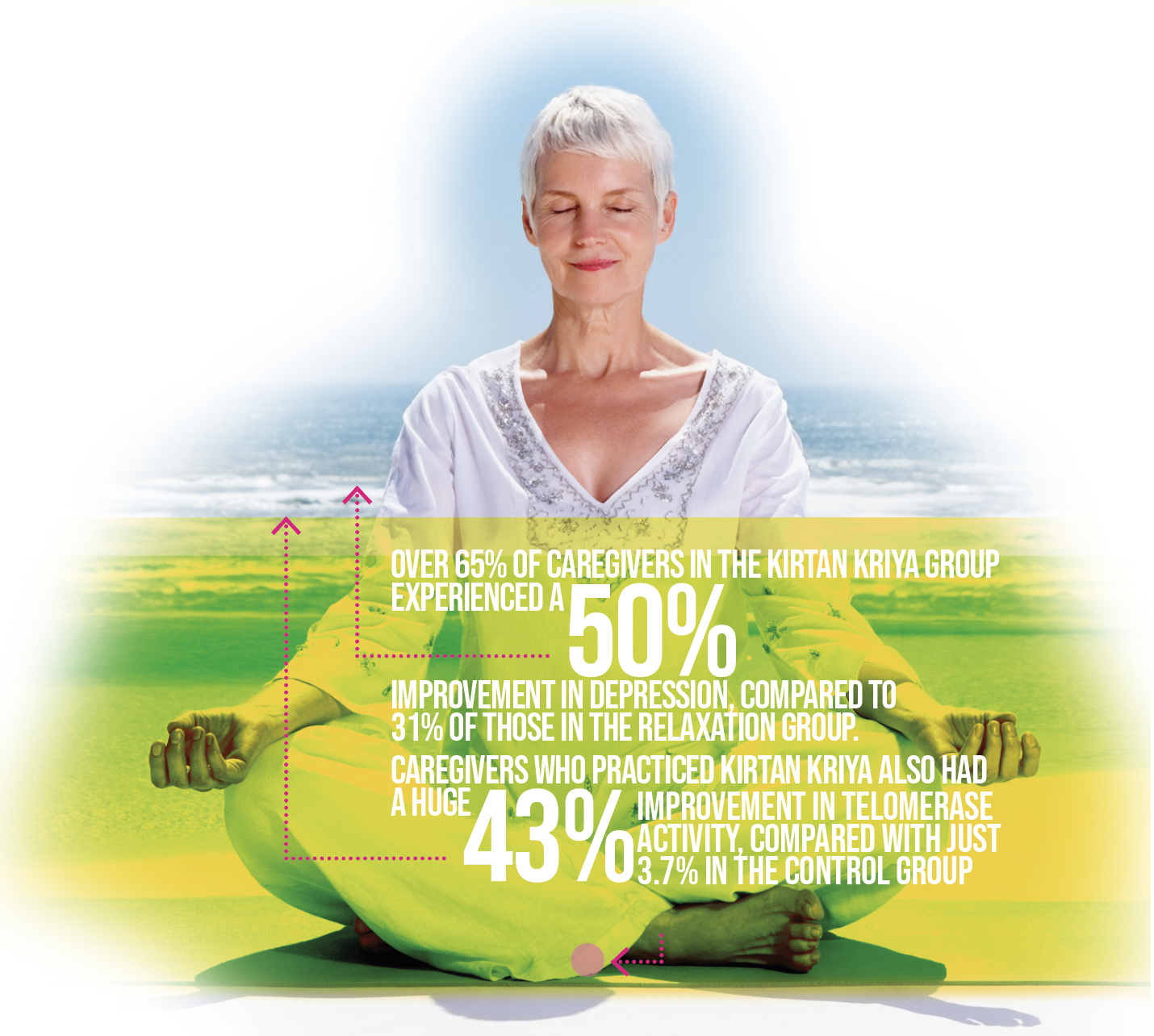
Over 65 percent of caregivers in the Kirtan Kriya group experienced a 50 percent improvement in depression, compared to 31 percent of those in the relaxation group. Caregivers who practiced Kirtan Kriya also had a 43 percent improvement in telomerase activity, compared with just 3.7 percent improvement in the control group.9
Telomeres are caps on the ends of chromosomes that fray and get shorter when a cell divides. Without the enzyme telomerase rebuilding the telomeres, a cell is unable to replicate and eventually dies.
The Kirtan Kriya results compared favorably with participants in a three-month intensive meditation retreat in Colorado as part of the Shamatha Project, a longitudinal study led by investigators at the University of California, Davis. Telomerase activity among meditators was also significantly higher than that of non-meditators.10
Researchers speculate that by protecting telomeres, meditation might slow down cellular aging. “Telomeres degrade with age and with chronic stress,” says Sat Bir. “So anything you can do to maintain your chromosome integrity is critical because that’s the core function of how organisms work.”
The short 12-minute version of this meditation practice (pronounced KEER-tun KREE-a) is a Kundalini yoga practice introduced to the West by the Indian-born spiritual teacher Yogi Bhajan in the 1970s.
Kirtan Kriya is also known as a singing meditation. It involves repeating the mantra saa taa naa maa first out loud with a specific melody for two minutes, then in a whisper for two minutes, followed by a silent repetition for four minutes, then back to the whisper for two minutes before finishing aloud for the last two minutes.
The syllables of the mantra represent the cyclical nature of existence: saa (birth, infinity, cosmos), taa (life, existence), naa (change, transformation, death) and maa (rebirth).
Each syllable corresponds to a different mudra (hand movement) as the meditator moves the thumb on each hand to touch the tips of each finger: saa (the tip of the thumb touches the index finger), taa (the thumb touches the middle finger), naa (the thumb touches the ring finger) and maa (the thumb touches the little finger).
Practitioners are advised to imagine energy coming down in an “L” shape through the crown of the head and bending at a right angle through the “third eye” point between but slightly above the eyebrows. There are many videos on the internet discussing Kirtan Kriya.
One useful animation can be found at: www.youtube.com/watch?v=jfKEAiwrgeY

But how could such a brief practice produce such dramatic results? The answer may be found in the dynamic nature of the meditation.
The Kirtan Kriya practice is divided into short, alternating periods of chanting a four-syllable mantra out loud and then whispering the mantra, before repeating the chant silently—all while touching the thumb to different fingers in synchrony with each syllable.
“Kirtan Kriya involves multitasking, and that’s what we saw on the brain scans,” says Lavretsky. “It uses a lot of attention pointers and requires a lot of remembering and sequencing. That’s the best kind of exercise: when you have to multitask, basically. It trains the frontal lobes and executive functioning.”
The frontal lobe of the brain is responsible for a range of “higher” cognitive functions relevant to cognitive decline, including impulse control, decision-making, retaining long-term memories, language and speaking. It is also a key mediator of the personality.
Lavretsky says the benefits of meditation are compounded when accompanied by body-based practices such as tai chi and yoga that expand the concept of mindfulness to its fullest dimension.
“It involves more components, like attention on breathing, movement, the position of the hands and the eyes, chanting and visualization,” she says. “So it activates more brain areas than mindfulness.”
Lavretsky was part of the research team that divided 81 people with mild cognitive impairment (MCI) into a group that practiced Kundalini yoga weekly and Kirtan Kriya daily, and another that underwent the gold-standard control therapy of MET, or memory enhancement training .
Both groups showed significant improvement in memory at 12-week and 24-week follow-ups, but only the yoga group had a major improvement in executive functioning, mood and resilience.11
“I believe that the physical and breathing practices of yoga will facilitate and enhance meditation,” says Sat Bir. “And many people who are experienced meditation teachers recognize this. [Mindfulness pioneer and teacher] Jon Kabat-Zinn has been starting his lectures by saying if you practice mindfulness, you should also be practicing yoga.”
In a separate UCLA study published this year, the practice of Kundalini yoga and Kirtan Kriya was found to decrease gray matter atrophy in women with subjective cognitive decline compared to MET. The result suggested that yoga training may have neuroprotective effects even over the short term.12
“What happens with aging is that we start to lose our gray matter,” says Sat Bir. “It starts to deteriorate. And what we’re seeing is that yoga can sustain regions of the brain. It prevents that decline in brain volume and brain matter [associated with aging], which goes together with maintaining and improving memory function and other types of cognitive functioning.”
Newberg also cites a body of research that has shown that long-term meditators have thicker frontal lobes than non-meditators do.
“I like to use the muscle analogy that, if one goes to a gym and lifts weights, that person’s muscles become thicker and stronger,” he explained in a 2015 interview.13 “In a similar way, if one lifts ‘mental weights’ by doing a meditation practice, that person’s brain literally becomes thicker, stronger and more functional.”
While meditation, mindfulness and body-based practices such as yoga have a slew of potential advantages relevant to cognitive decline, teasing out the individual pathways underlying those benefits is much harder.
A review of 10 studies of mindfulness-based practices and Kirtan Kriya by a team led by researchers from Western Sydney University in Australia found improvements across all types of practices, including a reduction of cognitive decline and stress, as well as increases in functional connectivity, brain volume and cerebral blood flow in the cortex.14
However, two other separate meta-analyses found no statistically significant benefits from mindfulness-based interventions targeting people with dementia and mild cognitive impairment,15 with the exception of decreased depression symptoms among dementia patients.16 Both reviews were limited by a small sample size.
Headline-grabbing studies of long-term meditators may only muddy the waters.
In one joint American, Australian and German investigation of the biological brain age of long-term meditators using pattern-recognition imaging, those devoted to the practice had brains that were seven and a half years younger than their chronological age of 50—and women’s brains were three years younger than men’s.17
However, the researchers admitted that the results could be attributed to the possibility that long-term meditators had healthier lifestyles overall.
The question of which type of meditation to practice and for how long is highly individual, with no one-size-fits-all practice. Scientists have divided common Buddhist meditation techniques into three broad types.
The first type, focused attention meditation, maintains awareness on a single point, usually the breath, a mantra, a visual or mental construct, or an external object such as a candle flame. This is sometimes called “calm abiding meditation” and is a common form of meditation in the yogic tradition.
Open monitoring meditation does not focus on a fixed point but cultivates a meta-awareness of passing thoughts, feelings and sensations. In the Buddhist context, it has been called “choiceless awareness.”Loving-kindness meditation extends unconditional positive regard to others to enhance empathy, compassion and selflessness. Loving-kindness is a translation of the Pali word metta. 18
A similar breakdown in meditation techniques was studied in 2020 by a German team of researchers who tracked 332 participants across three separate three-month meditation modules.
The attention module focused on monitoring breathing and using a body scan, the second module used a loving-kindness meditation, and the last module cultivated socio-cognitive skills through simply observing thoughts as they arose, nonjudgmentally.19
Meditators reported specific improvements in each of the categories, but their combined effect was greater. “These results show that specific mental training practices are needed to induce plasticity in different domains of mental functioning,” the authors wrote.
“However, training-related effects on compassion were smaller for the group practicing [loving-kindness] without first learning how to stabilize the mind in the [attention] module.”
Lavretsky says the best practice for people suffering cognitive decline is simply the one that is easiest to learn and adopt. “It cannot be very challenging or something completely new for people who are losing their cognitive abilities, because it’s harder for them to learn new skills. So when we’re teaching our classes, it’s really simplified.”
Alzheimer’s, a degenerative brain disease characterized by impaired memory, thinking, behavior and emotional regulation, accounts for 60–80 percent of cases of dementia, and two-thirds of those affected are women. Among the clinicians surveyed by Alzheimer’s Disease International, inadequate knowledge about how to make a diagnosis hampers early detection.
Much hope for the future treatment of Alzheimer’s rests on the validation of more affordable diagnostic methods, such as blood tests and genetic risk profiling.
In June 2021, the US Food and Drug Administration controversially fast-tracked authorization of the intravenous drug aducanumab (Aduhelm) for the treatment of mild cognitive impairment or the mild dementia stage of Alzheimer’s, against the advice of its own advisory panel. The FDA announced that the drug, designed to remove beta-amyloid plaques, was the first approved “therapy to target and affect the underlying disease process of Alzheimer’s.”1
However, in an indication that the FDA may have rushed the drug to market, Medicare administrators in the US last April said they would offer only limited coverage for Aduhelm because trial data had failed to show “meaningful improvement in health outcomes” for patients.2
The Buddha’s antidote to suffering, or dukkha in his original Pali language, remains as relevant as ever in the modern world, where living longer has only underscored the Buddhist doctrine of impermanence and change.
A 2020 report on Alzheimer’s prevention, intervention and care by the Lancet Commission estimates that up to 40 percent of the risk factors for dementia are subject to behaviors that can be changed. It cited 12 modifiable factors, including hypertension, depression, physical inactivity and low social contact, that account for 40 percent of dementia cases globally.20
In a paper published in the journal Cerebrum, the president and medical director of the Alzheimer’s Research and Prevention Foundation, Dharma Singh Khalsa, identified the four pillars of Alzheimer’s prevention as diet and supplements, physical and mental exercise, yoga and meditation, and psychological wellbeing.21
“The secret may lie in epigenetics, the effect one’s lifestyle has on one’s genes, and thus on the risk for disease,” he writes.Studies also point to loneliness among older adults as a dementia risk factor around which other social and environmental vulnerabilities coalesce.
A team of researchers from New York University’s Grossman School of Medicine examined the relationship between loneliness and dementia among 2,308 men and women with an average age of 73 in the decades-long Framingham Study.
All were dementia-free at baseline, but those aged 60 to 79 had more than a twofold likelihood of developing dementia over the next 10 years if they were lonely.22
Loneliness was also linked to poorer executive function, cerebral atrophy and damaged white matter in the brain. Sat Bir adds: “There are regions of our brain which require social interaction. We are social animals. The likelihood is that loneliness does generate this sense of chronic stress and emotional disturbance, which yoga can quiet.”
A Carnegie Mellon University study was the first to show that mindfulness meditation decreased loneliness in older adults. It followed the progress of 40 participants aged 55 to 85 in an eight-week mindfulness-based stress reduction program and found the program reduced not only loneliness but also pro-inflammatory gene expression.23
Why would such a solo practice decrease loneliness? For Lavretsky, this is where science and spirituality merge and where contemplative practices such as meditation lead to the larger questions of life, death and aging.“Even if you don’t believe in God or whatever, you would be, by virtue of practicing, opening yourself up to a greater reality of life that it’s not just you in the room—it’s also beyond. And once you get to that point, you’re never alone.”
Main References
|
References |
|
|
1 |
Lancet Neurol, 2019; 18: 88–106 |
|
2 |
Alzheimer’s Disease International, “World Alzheimer Report 2021: Journey through the Diagnosis of Dementia,” 2021. www.alzint.org |
|
3 |
Biol Psychiatry Global Open Sci, 2022; doi: 10.1016/j.bpsgos.2022.01.001 |
|
4 |
JAMA Neurol, 2014; 71(4): 505–8 |
|
5 |
Alzheimers Dement, 2016; 12(3): 292–323 |
|
6 |
Alzheimers Dement, 2020; 16(7): 1054–64 |
|
7 |
J Alzheimers Dis, 2010; 20(2): 517–26 |
|
8 |
J Neurosci, 2020; 40(44): 8573–86 |
|
9 |
Int J Geriatr Psychiatry, 2013; 28(1):57–65 |
|
10 |
Psychoneuroendocrinology, 2011; 36(5): 664–81 |
|
11 |
Int Psychogeriatr, 2017; 29(4): 557–67 |
|
12 |
J Alzheimers Dis, 2022 Mar 11. doi: 10.3233/JAD-215563 |
|
13 |
Altern Complement Ther, 2015; 21(1): 13–17 |
|
14 |
Rev Neurosci, 2018; 29(7):791–804 |
|
15 |
PLoS One, 2021; 16(8): e0255128 |
|
16 |
West J Nurs Res, 2020; 42(12): 1163–73 |
|
17 |
Neuroimage, 2016; 134: 508–13 |
|
18 |
Sci Rep, 2020; 10(1): 7430 |
|
19 |
Cognition. 2020; 194: 104039 |
|
20 |
Lancet, 2020; 396 (10248): 413–46 |
|
21 |
Cerebrum, 2017: cer-03-17 |
|
22 |
Neurology, 2022; 98(13): e1337–48 |
|
23 |
Brain Behav Immun, 2012; 26(7): 1095–101 |
What is mindfulness?
|
References |
|
|
1 |
J Clin Pyschol, 2006; 62(3): 373–86 |
The rush to market
|
References |
|
|
1 |
US Food and Drug Administration, News release, June 7, 2021. www.fda.gov |
|
2 |
US Centers for Medicare & Medicaid Services, Press release, April 7, 2022. www.cms.gov |
What do you think? Start a conversation over on the... WDDTY Community

Great news! Discounts are available based on your cart total. Check the details below: