Sometimes you have to take a prescription drug – but be careful when you do. Aside from the risk of suffering an adverse reaction or side-effect, which happens on average to 10 percent of people taking a drug, the chances that there’s been an error in the prescription is also very high.
Around 20 percent of all prescriptions contain an error – from the wrong dose to the wrong drug – and these mistakes could be killing up to 22,000 Britons every year. A similar rate of error, and death, is happening in every country around the world, the World Health Organization (WHO) has warned.
Discovering the rate of prescription errors is difficult – often because it’s hard to track, since most prescriptions are handed out at the local pharmacy while errors in hospitals are often covered up – and so it’s something researchers haven’t looked at too closely.
Serious error
So, when an English research team decided to find out, they were alarmed at what they found. They discovered that 237 million medication errors happen every year in England, and that’s around 20 percent of the 1.1 billion prescriptions written in the UK.
Of these, about 72 percent are minor and usually harmless, but 2 percent cause great harm or even kill the patient. This means around 4.74 million people are victims of a serious error every year in the UK alone, and more than 1,700 people die as a result.
Most die from stomach bleeds after been given the wrong dose of an NSAID (nonsteroidal anti-inflammatory drug) or a blood thinner such as warfarin. Other drugs that are most likely to be wrongly prescribed include antiplatelet drugs, anti-epilepsy medication, drugs for low blood sugar, diuretics (so-called “water pills”), inhaled corticosteroids to control asthma attacks, and heart drugs such as beta-blockers.
Keep it quiet
But even this extraordinary error rate could be just the tip of the iceberg. They represent the errors that can be tracked, say researchers from the University of Manchester, such as in hospitals or care homes. The error rate among people who take their drugs at home can be guessed at, but it can’t be known.
They do know for sure that around one in five patients in an English hospital will take a drug that is either wrong or at the incorrect dose, and the problem is twice as bad in care homes, where it’s happening to 42 percent of elderly residents.1
Errors don’t only have a human cost. The Manchester researchers estimate that they cost the UK’s National Health Service at least £1 billion every year, which includes the added care the patient needs after an error, assuming they survive it.
Globally, that figure could be around $42 billion a year, the WHO estimates, and it has challenged health authorities to halve the error rate by 2022. To highlight the problem, the WHO designated September 17 as World Patient Safety Day, when landmarks around the world – including the Pyramids in Egypt and the Kuala Lumpur Tower – will be lit up in orange.
How it happens
Reducing the number of mistakes could be a challenge because there are so many moving parts in the process of prescribing a drug. The Manchester researchers discovered that more than half the errors happened during the administration procedure, suggesting the wrong drug or dose – or both – is selected at the outset.
Further error creeps in when the doctor writes out the prescription, with one in five containing a mistake, and the final 16 percent happen when the drug is finally dispensed to the patient.
The WHO agrees. Errors are creeping in during diagnosis, prescribing and treatment, says its patient safety coordinator Dr Neelam Dhingra-Kumar. “These mistakes occur because healthcare systems are not suitably designed to deal with them and learn from them,” he said.2
And it’s hard to learn lessons when hospitals and doctors close ranks and hide the mistake, he added. The extent of the cover-up has unfolded as research group after research group has looked at prescribing errors, and medical mistakes in general, over the years.
In 1999, the Institute of Medicine estimated that around 98,000 Americans die each year from medical error, also known as iatrogenic death. By 2010, researchers found the problem was twice as bad, with 180,000 victims of mistakes. In 2013, another study put the annual iatrogenic death rate in the US at 440,000.
Almost as an understatement, the report from Patient Safety America concluded: “The epidemic of patient harm in hospitals must be taken
more seriously.”3
With those numbers, medical errors are the third leading cause of death in the US, after heart disease and cancer.
Correct, and still lethal
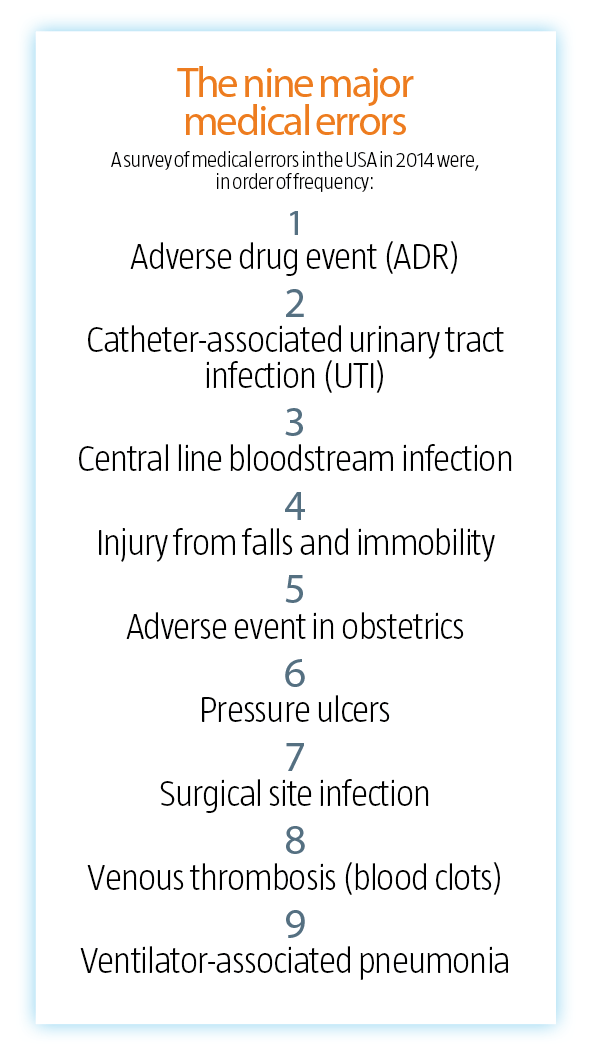
But start adding back in those who die from an adverse reaction to a drug that has been correctly prescribed, and the true picture gets even scarier. Not only are adverse drug reactions (ADRs) the cause of 3-7 percent of hospitalizations, but among people who are already hospitalized for any reason, that rate more than doubles to 10-20 percent.4
The correct death rate is harder to come by, but one meta-analysis that looked only at data from hospitalized patients found that 0.3 percent had an ADR that was ultimately fatal, suggesting at least 106,000 patients die in a US hospital every year as a direct result of an ADR.5
But it could be worse still, depending on the age of the patient and their general health. A small study in a hospital in São Paulo, Brazil, which monitored just 472 patients, discovered that 75 patients suffered 94 ADRs, meaning some patients had more than one reaction. The results suggested that roughly one in 100 patients would suffer an ADR every day, and the most vulnerable were the elderly and those with renal (kidney) failure.6
But can we rely on these figures, gloomy as they are? Unlikely, says the Drug Safety Research Unit in the UK, which created the country’s “yellow card” reporting system for doctors. They estimate that only half of ADRs are ever reported by either doctors or hospitals.
Reactions to new drugs are the most likely to be reported – usually because their safety isn’t known and doctors are more vigilant – but this also suggests the older and more trusted drugs are not being suspected of causing a serious ADR when, in fact, they are.7
Of course, doctors and pharmacists don’t mean to make these mistakes. They are often the result of faulty systems, processes and conditions, says Niki Carver, coauthor of the report Medical Error (StatPearls Publishing, 2020). But until doctors and hospitals recognize the extent of the errors, and own up to them, nothing will improve.
Medical Error, StatPearls Publishing, 2020
The cost of medical error
•Medical error costs the US healthcare system around $20 billion every year
•Around 12 million Americans are misdiagnosed every year
•Up to 440,000 Americans die each year as the result of medical error
•Up to 22,000 Britons die each year because of medication error
•The global cost of medical error is around $42 billion every year
Getting it wrong
It all starts with a diagnosis – and that’s exactly where most medical errors happen. A study of claims against doctors discovered that the vast majority were the result of a failure to diagnose, delaying a diagnosis or making an incorrect diagnosis.
The root of many of these
errors was down to the doctor’s own perception of the problem. Either they wouldn’t consider a different diagnosis, ignored abnormal findings or failed to order tests, presumably because they thought they knew what the problem was.
The other common complaint was that the doctor failed to seek a second opinion or discharged the patient too early from emergency care.
Common ailments missed by a doctor included stroke (acute cerebral vascular accident), heart attack (myocardial infarction), pulmonary embolism (blood clot in the lung), lung cancer, fractures, meningitis and appendicitis.
Risk Management Monthly, 2016; 11
|
References |
|
|
1 |
BMJ Qual Saf, 2020; bmjqs-2019-0102062. |
|
2 |
India Today, September 14, 2019 |
|
3 |
J Patient Saf, 2013; 9: 122-8 |
|
4 |
Agency for Healthcare Research and Quality, HCUP Statistical Brief #234. January 2018. |
|
5 |
JAMA, 1998; 279: 1200-5 |
|
6 |
Clinics, 2018; 73: e1857. Drug Safety, 2006; 29: 385-96 |
What do you think? Start a conversation over on the... WDDTY Community

Great news! Discounts are available based on your cart total. Check the details below: