Beyond their beauty, wildflowers flourishing in parks and on pathsides can offer potent healing benefits, says herbalist Ali English. Here are three of her favorite flowering herbs for helping to heal everything from hot flashes to hay fever
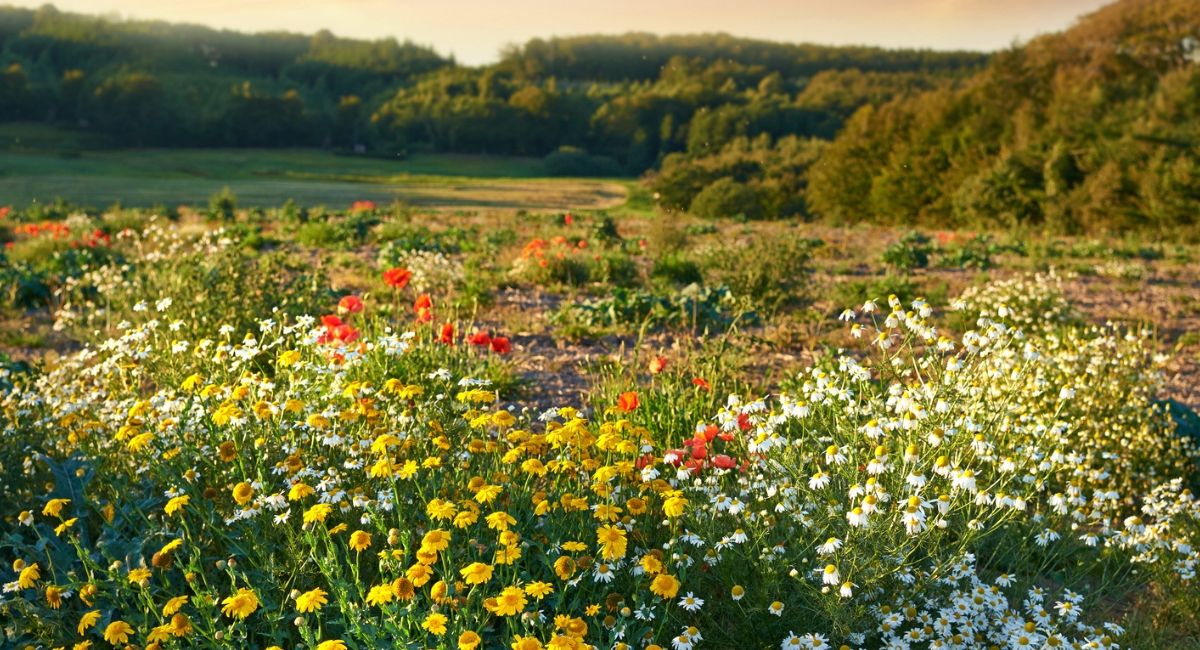
Many people are rediscovering the joys of gathering their own natural medicines, turning to hedgerows, woodlands, gardens and commons to create a home herbal apothecary. Summer is an ideal time to forage, with many medicinal plants in full growth and easy to identify. It’s also prime season for picking flowers, as plenty are at their peak potency when freshly opened.
Here are three of my all-time favorite healing herbs with a multitude of medicinal uses. They’re easy to find in the wild or would make a beautiful addition to your yard or garden if foraging’s not for you. You can also buy them online as dried herbs or ready-to-use tinctures, salves and ointments.
Just remember to never consume or use wild plants unless you are completely sure of their identification—some can cause serious harm or even death if misidentified. Always use a trusted field guide, learn from an experienced forager, and avoid harvesting from polluted areas or protected land.
Calendula officinalis
Parts used: Flowers and leaves
When to gather: June through September, on hot, sunny afternoons
While not strictly a wildflower, Calendula self-seeds easily and adapts well to naturalized spaces, so it’s often found growing wild. More commonly, though, it’s grown as an annual garden flower from seed and produces glorious orange and yellow flowers all through the summer—sometimes right through to December if the weather is mild.
Calendula likes plenty of sun and prefers reasonably well-drained soil. If you’re growing it at home, it will thrive just as much in pots as it does in the garden. Just make sure the plant is not overwatered.
Medicinal use
Calendula is one of the most versatile and well-known herbs in the herbalist’s arsenal. Used topically, it’s fantastic for wounds, helping to stop bleeding and acting as an antiseptic when applied as a tincture or cream. It’s especially good for infected wounds, helping to cleanse the injury and removing pus (in this scenario, it’s best to take the herb internally as well as applying it to the wound directly).
It is also useful for insect bites, sunburn, scratches, rashes, sores and inflammatory skin conditions like acne, eczema and psoriasis. Basically, for anything wrong with the skin, calendula is your herb.
Used internally, calendula is useful for treating illnesses caused by damaged or impaired liver function, such as jaundice, hepatitis and cirrhosis. Plus it’s soothing to mucous membranes around the whole body, including the digestive system.
Calendula is also an effective herb for various women’s health issues, like period pain and PMS, irregular cycles, and perineal tears caused by childbirth. During labor, calendula can be used to gently promote contractions and encourage delivery of the placenta.
Suggested dosages
Tea: 2 tsp of dried herb in a cup of hot water three times a day, or more often as a bath or a wash
Tincture: Up to 10 mL (2 tsp) a day, depending on what you are trying to treat; as part of a prescription, use no more than about 30 mL (2 Tbsp) per week in a formula
Contraindications
None known at present, but the plant is a member of the daisy family and could cause skin irritation to anyone with an allergy to plants in that family. Given that it can be used to promote contractions during labor, I recommend giving it a miss during pregnancy.
Lonicera periclymenum
Parts used: Mainly flowers, sometimes leaves
When to gather: June through September
A popular garden plant, honeysuckle can also be found growing in woodlands and scrambling up country hedges and train-track banks. It prefers to grow in light shade where possible.
The strongly scented flowers are long and slender, with extravagantly trumpet-shaped openings, and usually warm golden yellow, often with a pink tone to them, especially as they age. The flowers are followed by poisonous red berries in the autumn.
Common honeysuckle is often found in garden centers and can be grown easily in the garden, doing best in moderately fertile, moist soil with a good bit of support. Pruning the plant back regularly can often result in better flowers.
Medicinal use
Honeysuckle seems to have fallen out of use in the UK, but American herbalists use it for coughs and colds as a tonic rich in vitamin C and also for headaches linked with heat. I have found it helpful for this as well as for headaches from a sudden rise in body temperature due to stress, panic or anger.
Honeysuckle has also been used as an expectorant to help the body rid itself of unnecessary phlegm and as a cooling laxative for overheated systems. Because of its cooling properties, any other “hot” conditions—from menopausal hot flashes to inflamed joints—may well benefit from honeysuckle.
The presence of salicylic acid makes honeysuckle anti-inflammatory and painkilling as well as cooling, so it’s ideal for treating inflammatory conditions like arthritis.
Used topically, it makes a wonderful cooling, soothing skin wash for sunburn, eczema, insect bites and stings and other itchy skin issues. As an infused oil, it works well for chilblains, rheumatism and arthritis, especially where redness and heat can be seen around the joint.
Suggested dosages
Tincture: 2.5 mL (½ tsp), made cottage-style (see Making your medicine, below), up to three times a day; more often than this will cause nausea
Elixir: 5 mL (1 tsp) of the elixir up to three times a day
Infusion: 1 tsp, heaped, of dried flowers infused in a cup of water twice a day, or roughly 10 fresh flowers (individual ones, not flower heads) infused in hot water twice a day
Contraindications
High doses can cause nausea and vomiting.
Prunella vulgaris
Parts used: Aerial parts (parts above ground)
When to gather: July to late August or early September, depending on the weather
This low-growing perennial thrives in scrubland, grasses, meadows, the side of the road, the middle of the veg patch—anywhere it can get its little roots in. It is a tenacious but beautiful little survivor, with whorls of leaves growing around the familiar squarish stem of the Lamiaceae family.
The flowers have the hallmark appearance of this plant family as well and are deep, rich purple, appearing in an almost cylindrical head at the top of a stem that rises above the basal set of leaves and features paired leaf sets.
Self heal can be sown directly in the garden in late spring or early autumn but also does well germinated in trays. I find it rarely stays where I plant it in the garden, preferring to escape and colonize the grass, so don’t be too surprised if you find it popping up all over the place within a year or so of planting.
Medicinal use
Self heal has such a plethora of uses that it deserves to be a part of every herbal medicine chest. As a tea, it can soothe the discomfort of sore throats and the irritation of chest infections. The cold infusion of the herb can be used to calm hot flushes.
It can also be used to speed the healing of injuries when used topically as a salve or taken internally.
Self heal is a fantastic herb for treating feverish colds and flu, especially where the illness has led to raised glands. It may have some value in treating glandular fever too.
Self heal can stimulate the immune system and soothe inflammatory responses that cause illness and pain. It can help calm allergic responses, so it combines well with eyebright, plantain, nettle, ground ivy and mullein in the treatment of hay fever and problems related to seasonal change.
The herb can be used for the digestive system and to relieve hepatitis, jaundice and simple diarrhea. According to some sources, it improves the body’s ability to cope with diabetes by having an action on the pancreas.
It’s also used to lower high blood pressure and resolve edema (swelling caused by a buildup of excess fluid) and as a general kidney tonic. In China, the herb is used as an anticancer treatment, as it has antioxidant and antimutagenic properties.
Suggested dosages
No more than 10 mL (2 tsp) for a solo dose
Tea: 1 tsp, heaped, of the herb in a cup of hot water, drank three or four times a day
Contraindications
None known.
Unless you happen to live on or have access to organic farmland, I recommend you don’t gather from field margins, as there’s no telling what the farmers may have sprayed on their crops. Many of our native medicines used to grow merrily among the wheat and corn. Sadly, most of these are becoming increasingly rare in the wild, so if you have a small bit of land, or even a yard and some pots, try growing some of them for yourselves.
If you are gathering from the wild, try to pick from areas that are free from pollution, be it airborne or animal-borne—dog wee, for example, doesn’t make good seasoning! Gather above dog height if possible, and if you’re aiming to dry your herbs, gather them on a dry day, once the dew has evaporated.
Pick only healthy plants with no spots, fungus or withered bits. Look for good green foliage, and pick only a third of what is there. As a rule of thumb, if you can see where you have been, you have gathered too much.
Herbs can be used fresh (see the recipes below), but drying them allows for a longer shelf life and enhanced potency. To dry herbs, tie them in bunches of up to 12 stems (use elastic bands as plants shrink as they dry), then hang them in a cool, well-ventilated room that doesn’t get too much direct sunlight.
Smaller bits of plants, leaves and flowers can be dried in baskets and are easy enough to turn over every day, either by hand or by giving the basket a gentle shake.
Plants are dry when they break reasonably easily: they should still look like their fresh versions, just smaller and more desiccated. If, when you have finished, a plant looks gray or brown and doesn’t smell of much or actively smells bad, it hasn’t dried properly and should be composted.
To store your herbs, clean, dry glass jars work well. Chop the herbs using kitchen scissors and pack them into jars, labeling them carefully with their English and Latin names and the date.
Bear in mind that the smaller your herbs have been chopped, the larger the surface area exposed to air, which means they may not last quite as long. I tend to store my herbs in larger pieces and chop them later, according to need.
Dried herbs should be stored out of direct sunlight and will usually last up to two years, though it does vary fairly widely between herbs. Go by eye, scent and taste—if it looks and smells good and still has a strong, vibrant flavor, it will almost certainly still be absolutely fine to use. If it has faded and doesn’t taste or smell of much, compost it.
The best way to take herbs depends on the individual plant and what you are trying to treat, but here are some of the most common and effective ways to prepare medicinal herbs.
Decoctions and infusions
Straight-up infusions can be made by pouring hot (just off the boil) water over the herb, covering the cup and steeping it for five minutes. The infusion is then either drank, added to bathwater or frozen in ice-cube trays.
Short-term decoctions can be made by boiling the herb in water until the quantity has reduced by half, then either taking smaller doses of it throughout the day or freezing it in ice-cube trays.
Long decoctions often don’t need to be stored in the freezer. They’re made by finely chopping herbs or roots and boiling them in plenty of water—assume 570 mL (20 fl oz) of water to 2–3 Tbsp (30–45 g) of chopped herbs, topping the water level back up as it reduces and keeping the whole lot simmering for up to four hours. After four hours, simmer without topping up until the quantity has reduced by at least half.
Tinctures, elixirs and honegars
These are all made in similar ways and usually involve either alcohol or vinegar—I usually recommend unpasteurized cider vinegar. It often preserves the herbs for much longer periods, and only a small dose is needed to be medicinally effective. It also has the advantage of speed for those with a busy lifestyle.
Tinctures and elixirs are basically herbs chopped and infused in alcohol. In the case of an elixir, a sweetener is added, usually honey.
To make a cottage tincture, chop plenty of the fresh or dried herb, pack it into a jar and pour over the alcohol, allowing an extra 1.25 cm (½ in.) of liquid on top of the herb. Let the whole lot steep for at least a fortnight, then strain and bottle, labeling carefully with the English and Latin names and the date of bottling.
Be aware that the stronger the alcohol, the longer the tincture will last. Also, if you use fresh herbs, remember that their extra water content will dilute the tincture. For a stronger tincture, wilt the herbs for a few days beforehand or dry them entirely (see Drying and storing herbs, above). If you’re making an elixir, just add honey along with the herbs.
Honegars are made in much the same way, but using unpasteurized cider vinegar instead of alcohol, also with herbs and honey.
Infused oils, creams and salves
Infused oils can be made with a huge range of leaves and flowers from the hedgerow or herb garden; there are two main ways of going about this.
Sun-infused oils are effectively just the flowers, picked on a dry day and packed into a glass jar, with organic seed oil poured over. A piece of muslin or several layers of cheesecloth are tied onto the top, and the whole jar is then placed in the sun to infuse until the oil has changed color (see below for my calendula infused oil recipe).
Hob-infused oils are usually made in a double boiler, a slow cooker or a bain marie in the oven. Over time, the oil gently heats and extracts the properties from the plant.
To prevent your oils going rancid, make sure the plants you use are completely dry to the touch, and if your oil looks rather murky once you’ve finished infusing it, just pop it into a clean, dry glass jar or jug and leave it for a day or two. The murky content will usually sink to the bottom, allowing you to pour off the clear oil.
Salves and ointments are made by adding beeswax in various proportions to the finished oil; creams are made by adding aromatic water as well as beeswax.
Ingredients/equipment
Method
Ingredients
Method
Ingredients
Method
Adapted from Wild Medicine: A Seasonal Journey with Medicinal Plants by Ali English (Aeon Books, 2026). For 20 percent off the book, use code WILD20 at aeonbooks.co.uk (valid until August 31, 2026)
What do you think? Start a conversation over on the... WDDTY Community

Great news! Discounts are available based on your cart total. Check the details below: