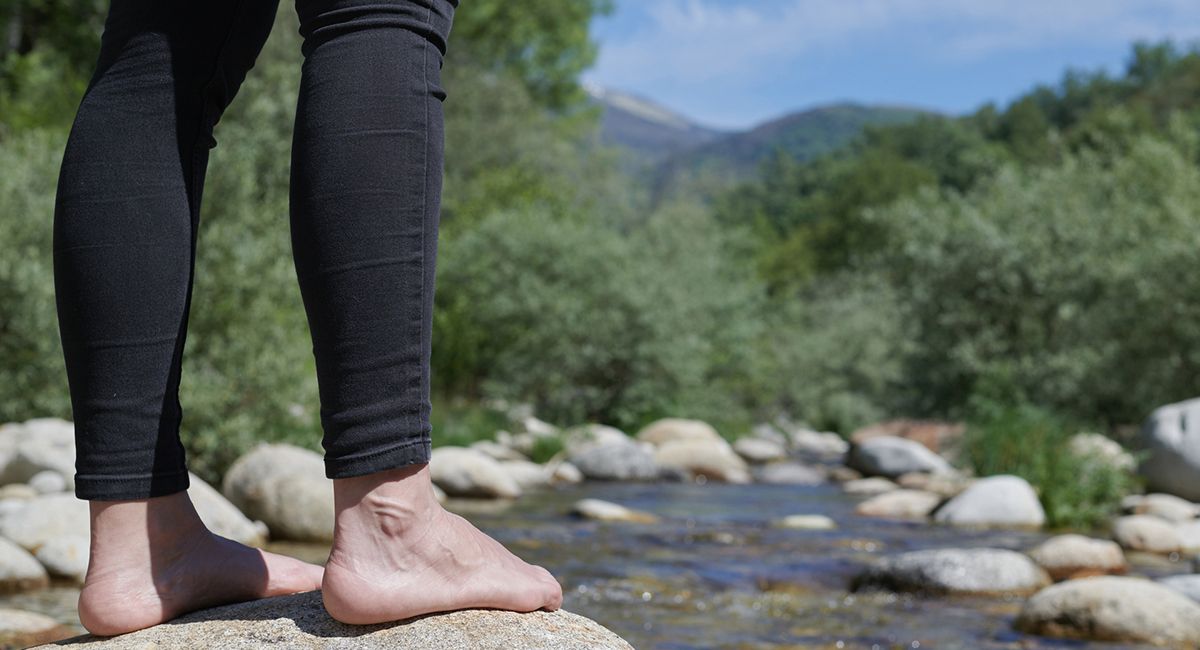
Barefoot shoes are having a moment, but are they really better for your body? Posture therapist Eleanor Dalton (“Posture Ellie”) thinks so and explains why switching to minimalist footwear could help relieve pain, improve movement and support long-term foot health
The feet contain more than a quarter of the bones in the human body, boast a vast quantity of powerful muscles and joints, and are impeccably designed with a complex arched structure—like an elegant cathedral designed by one of the greatest architects in history.
We have elastic Achilles tendons evolved specifically for running, propulsion and shock absorption. During our running gait, the Achilles tendon and the arch of the foot work together to return half the force of the body hitting the ground.1
Our feet are natural, explosive, shock-absorbing powerhouses. Additionally, each foot contains about 200,000 nerve receptors to feed the brain important information about the environment and situation we find ourselves in. Our feet and brain are like best mates who should be in constant communication with each other.2
Yet, unfortunately, this exquisite sensory feedback, muscular power and healthy foot structure begin to get stripped away and misshapen from a very early age. It begins whenever we start to wear modern shoes regularly.
The weakened feet of habitually shod populations are not representative of the powerful feet of habitually non-shod populations, and our perspective on what our feet supposedly need can be seriously misinformed and warped.
In my professional experience, one of the quickest and easiest ways to dramatically decrease pain throughout the body is to restore muscular function to the toes, arches, ankles, mid-foot and calves by doing the right posture exercises (see Do your feet work, below) and by transitioning to wearing barefoot or minimalistic footwear.
You can, quite literally, dissolve decades of knee, back, hip or neck pain overnight when you wake up your feet and start to wear footwear that allows them to move as nature intended.
Let’s look back to our early ancestors. They would not have worn shoes like the ones we wear today. Many people across the world still don’t. For most of human history, if shoes or sandals were worn at all, they were incredibly simple—created to protect against the elements (as we migrated to colder climes)2 and from acute damage like cuts and infections.
Because all the tissues in the body constantly respond to the load and demand we put on them, when we spend a lot of time outdoors and barefoot, dealing with friction and pressure, we develop thick calluses. These make our skin incredibly tough, like hooves,2 and deliver a good blood supply to the feet.3
Calluses are the body’s natural way of making us a keratin-based shoe. If we wear shoes, we don’t give the body the demand it needs to create these calluses. Without them, it’s hard to imagine how easy it is to walk across rough surfaces all day in bare feet.
Compare a typical sports shoe from the 1950s with the sports shoes of today and you can easily see how far shoe technology has come in a short time. I’m not saying 1950s sports shoes are optimal (many are too narrow, thick-soled and stiff), but they are far less complicated than the sports shoes we think we need today.
Padding and cushioned support in shoes came about only in the late 19th century with the invention of rubber and, more dramatically, in the 1970s with the invention of a plastic called EVA (ethylene vinyl acetate), which creates the wobbly foam heel that so many sports shoes now have.
This development of shoe technology over the past 100 years or so is not helping us as humans; it’s hindering us. Wearing pointed, cushioned, slightly heeled shoes is altering your natural human gait cycle. Over time, this change contributes to chronic biomechanical issues that eventually lead to pain in your body.
As with anything that uses support in place of muscular strength, modern shoes switch off our muscles (in this case, in the feet and lower legs). When the muscles become weak, it disrupts the efficiency of the human movement machine and leads to pain.
Wearing gait-altering, toe-deforming and/or wobbly foam “supportive” shoes is okay for a short amount of time or on the odd occasion, but the problem is that most of us are wearing these types of shoes most of the time and perhaps don’t realize the damage it’s causing.
Here are some reasons most modern shoes work against our natural design.
1. Toes naturally spread
All you need to do is have a look at a baby’s foot (before they wear shoes regularly) and you’ll see how the big and fifth toes spread wider than the rest of the foot. Every single joint in your body is important and plays its part in keeping you pain-free. Your toes are no different. We need our toes to help stabilize and ground the foot, but they also help us push off through the mid-foot during the gait cycle.
If your toes are deformed into a point by wearing restrictive shoes, your foot cannot be fully stable and you won’t be pushing off through your toes properly. Fundamentally, this alters your gait pattern.
I recommend wearing silicone toe separators (available online) to help spread out your stiff toes. Choose a pair that has an equal amount of space between each toe and that doesn’t get narrower toward the end, and wear them for as long as you can tolerate each day.
If your toes are particularly stiff, start by wearing them for only a few minutes a day. Slowly increase the time, and your body will adapt.
Wearing toe separators is also a great measure to see if the shoes you already have are wide enough in the toe box. If you can’t wear toe separators inside your shoes, your shoes aren’t human foot shaped.
2. Feet don’t have raised heels
If you wear high-heeled shoes, you know the sweet relief that comes when you take them off. This is because wearing high-heeled shoes angles our feet downward into a motion called plantar flexion.
Plantar flexion is an important part of the foot’s range of motion, but it’s not a position we want to be stuck in. Most normal shoes are heeled, albeit often marginally, and they keep our feet in a perpetual state of plantar flexion.
Having our feet angled downward without the ability to counteract the plantar flexion with full dorsiflexion (pulling the toes toward the shins) is tiring because it pitches the body forward on a constant diagonal. We then either overload the front of the feet/toes or pull the upper body back (out of this diagonal), thus overloading the lower back and creating strain. You cannot escape one of these two compensations when you wear even marginally heeled shoes.
Constant plantar flexion also keeps the calves and hamstrings in a state of overwork and tension. As these muscles become more dysfunctional, it prevents the hips and pelvis from moving correctly and creates a cascade effect of movement issues throughout the body.
We need flat soles on our shoes so our feet can plantar flex and dorsiflex equally, maintaining balance in our movement patterns from bottom to top.
3. Hard work keeps feet strong
Like all the other tissues in the body, our feet do not need cushioning—they need work. Cushioning takes away the body’s productive and natural fight against gravity, which strengthens it (when aligned and functional).
In the same way soft bedding and a squishy sofa allow our muscles to melt into a puddle, so do our cushioned shoes. Cushioning in shoes allows the muscles to switch off and become dysfunctional. Why would the foot muscles wake up when they don’t have to?
Conversely, having no cushioning in the shoe forces the foot to work hard through necessity. The more the muscles of the feet can work and operate powerfully, the more the other joints of the body are protected.
Cushioned footwear also means we are wobbling around on an unstable foundation, like constantly walking on a trampoline. Unstable foundations create unstable structures that will suffer wear and tear further up.
With this instability, is it any wonder so many of us roll our ankles and get hurt?
Feet are meant to strike firm ground, and contact with firm ground means they can push off with precision and power. If our feet land on an unstable surface, such as shoe padding, this wobble ricochets through the body into all the joints. The ankles rock side to side (and potentially lead to sprains), the knees wiggle and overload, and the whole upper body has to brace itself (read: stiffen) to prevent us from falling over.
Also, if we support the arches of the feet with an insole-type contraption, not only do we switch off the muscles in the arch of the foot but we also prevent the midfoot from properly flattening into pronation and lifting into supination as we walk, which is part of the natural gait cycle.
4. Feet need to wave
Thin soles allow each section of the foot to move individually, as it should. We can think of our walking gait as like a boat rocking forward and backward on the sea, with some side-to-side movement, too.
When we walk functionally (barefoot or in minimalistic shoes), we touch the floor with the heel, and the foot rolls onto the outside edge into supination (lifted arch position), then the mid-foot rolls down into pronation (flattened arch position) and then we land through the ball of the foot to push off powerfully from the big toe joint.
When barefoot, we run differently, with a much lighter, more mindful, more delicate gait pattern. The foot connects to the ground at the mid-foot, not the heel.1
Cushioned trainers encourage and allow a heel strike. If we are wearing thick, stiff soles with no movement to them, our feet do not receive all the nuanced movement of rocking our ankles, feet and toes through the gait cycle.
Stiff soles encourage us to land heavily in a heel strike and push off at the toe end of the shoe with little movement or shock absorption through the mid-foot. This pattern feeds into stiffness and dysfunction, particularly in the mid-foot.
Think of thick, stiff soles as turning your feet into trotters, making the whole length of your foot (heel, mid-foot, ball and toes) hit the ground almost at the same time. Such soles limit the ability of the foot joints to articulate.
The more your feet are stiff like trotters, the less stability and balance they will have and the more the other joints in your body will have to brace and compensate. The more the other joints brace and compensate, the more pain they are in.
5. Toes shouldn’t grip shoes
I’m afraid your Birkenstocks, sliders and flip-flops aren’t safe from my barefoot scrutiny. Because they’re not firmly attached to your feet, these types of shoes make you shuffle while you walk.
You can’t pick up your feet, lift your knees and swing your legs properly through hip flexion and extension when your body is also having to hold an unsecured shoe on your foot. If you spend a lot of time shuffling, you’ll eventually lose the muscular function that allows you to walk properly.
Additionally, shoes without secure fastenings often create a toe grip. The toes are forced away from their actual job of stabilizing the foot and pushing off from the ground. Instead, they’re distracted and waylaid into holding the shoe in place. If you knew how the exhaustion of your gripping toes feeds a line of tension through the rest of your body, you might be less inclined to wear unsecured shoes.
Please don’t be fooled into thinking Birkenstocks, sliders or flip-flops are barefoot shoes just because the sole is flat(ish) and they’re open-toed. They come with their own host of movement problems.
Unlike “normal” shoes, minimalistic/barefoot shoes are a genre of footwear that comprise five main components.
Your everyday footwear needs to meet all the criteria described above if you want to be able to move to your fullest capability and give yourself the best possible chance of living a life without pain. Some of my favorite barefoot footwear brands are Vivobarefoot, Wildsole, Earth Runners and Feelgrounds.
Also see Healthy Shopping: Barefoot shoes to free your sole.
For those wedded to the idea that your feet need the support of external technology (rather than functioning foot muscles), here’s a posture test. It’s a test for weak feet but also one of my favorite exercises for strengthening them.
Follow these steps to see if your feet are currently capable of performing one of their key functions: holding your body upright and stable.
Being able to hold this position easily and calmly means your feet are good at motions called pronation (rolling inward) and supination (rolling outward), like a boat bobbing sideways on water. If the feet are functional in these motions, they are used to stabilizing the rocking.
They may wobble a bit, but the rest of the chain (knees, hips, pelvis, spine, shoulders and head) is not really impacted or unstable. The feet can stabilize themselves.
If your feet are not functional through pronation and supination, they do not have the muscular strength to keep the rest of the joints in the body stable. The wobble at the feet also tugs at the whole structure upstream, causing instability and imbalance—as you may experience in this posture test.
The more we work to strengthen our capacity to move functionally through pronation, supination and the other motions available to our feet, the sturdier our feet become and the more stable and relaxed all the other joints in the body are, too.
Padded, supportive shoes take away the demand for this rocking motion, so we become increasingly dysfunctional in pronation and supination. As we become less capable of these types of movements, we become more dependent on the cushioning that likely caused the dysfunction in the first place.
A body held upright by strong feet is a much sturdier body to live in and one that suffers a lot less instability further up. Instability causes wear and tear in the joints and tension in overworking muscles. So, we don’t need cushioning in our shoes; we need foot strength.
If you found this test difficult, repeat it as an exercise every day, and soon enough you’ll become a lot more stable when you do it. You may notice aches and pains elsewhere in your body magically reduce, too.
If your muscles and joints struggle when you go barefoot or wear minimalistic footwear, this is your body trying to tell you that something needs to change. You need to pay attention to how the muscles all over your body are working. This is not just a foot issue.
When we mask our symptoms of foot pain (or possibly knee, hip or back pain) with cushioned shoes and insoles, it’s like taking a painkiller. Padding allows us to quiet the all-important pain messages we need to listen and respond to, and by doing so we allow the body to continue substandard movement patterns for longer. The longer we get away with moving poorly, the more our joints will suffer.
The cushioned shoes aren’t stopping your joints from wearing away; they’re simply preventing you from hearing crucial feedback. If you wear cushioned shoes to hide from pain—and especially while continuing with higher-intensity activities (like running)—the problem will insidiously get worse, but you just won’t feel it anymore.
At some point, the biomechanical issues that your body is trying to alert you to will shift elsewhere. If your movement patterns are substandard, padded shoes will numb you to your body’s feedback, whereas barefoot shoes will hold up a mirror to the problem.
Being barefoot or wearing minimalistic shoes is not causing your pain; it is simply allowing you to hear a message from your body that you need to listen to.
Switching to barefoot or minimalistic shoes is incredibly worthwhile if your goal is to stay pain-free for your whole life. Here are some tips to help with the transition.
Start gradually. If spending time barefoot or in minimalistic shoes causes you pain, keep your padded shoes on, but start working on your posture (see Do your feet work, above) to restore your movement patterns. Keep testing to see how it feels to spend short amounts of time barefoot. Your body will tell you when it’s ready.
If the tissues of the feet are especially weakened and if the structures above the feet are misaligned and bear undue load through the feet, transitioning safely and comfortably into barefoot shoes can take several months.
Wear toe separators. Widely available online, these help prepare your feet for more barefoot time and also help you move better.
Go barefoot outdoors. Do this whenever you can. Not only will it help you to move away from cushioned shoes, it’s also a simple way to practice earthing or grounding—the technique of physically connecting with the surface of the earth to improve health and well-being.
Adapted from Posture Power: How to Move Well and Why It Matters by Eleanor Dalton (Watkins Publishing, 2026)
What do you think? Start a conversation over on the... WDDTY Community

Great news! Discounts are available based on your cart total. Check the details below:


