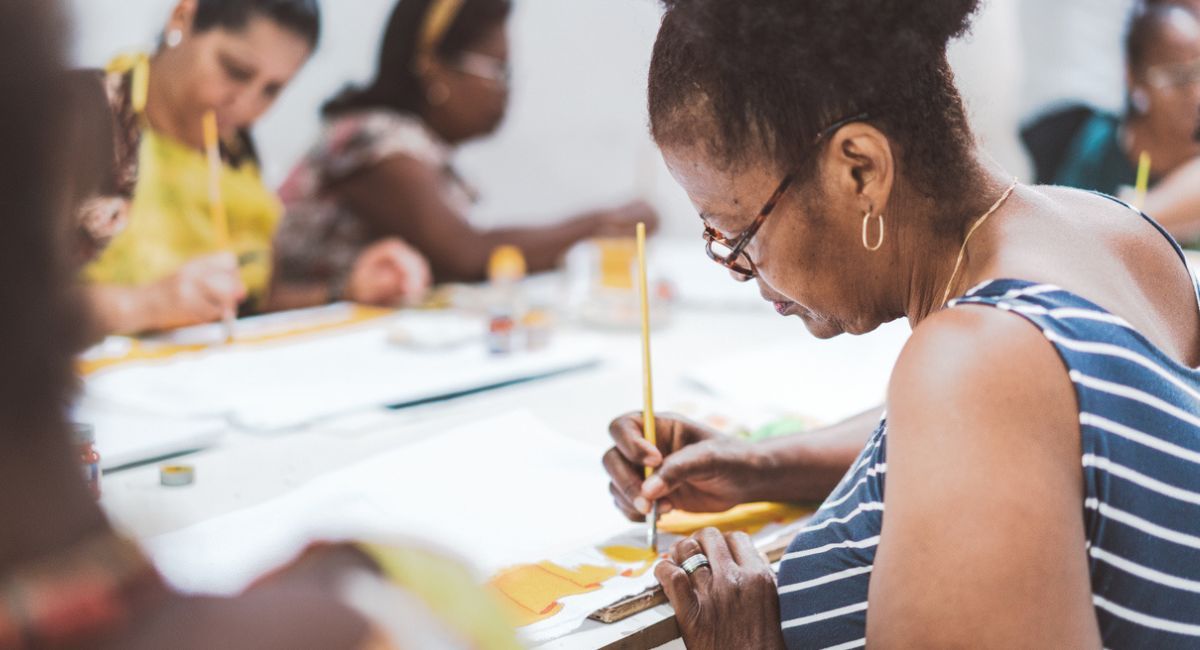
Germaine Hypher, who learned to navigate her severe myalgic encephalitis and fibromyalgia using creativity, reveals how arts and crafts can be powerful remedies for all sorts of health symptoms and conditions, both mental and physical
Arts and crafts have been used within medical and healing systems throughout the history of humanity. In the modern world, hospitals, support groups, clinical studies and people in their homes have repeatedly found arts and crafts beneficial for both physical and mental health problems.
It’s widely accepted that engaging with visual arts, musical arts and expressive writing (both as an active participant and as an appreciator of others’ work) can reduce stress levels. But it’s less well known that creative practices can have a positive impact on patients’ vital functions, nutrient levels, immune function, motor skills, mental agility, physical pain, insomnia and depression.
Here’s how creativity in general impacts the brain and the specific creative practices that can bring big benefits to your health, especially if you’re living with a chronic condition.
Neuroplasticity is the brain and nervous system’s ability to change through exposure to experience. It’s enhanced by practicing any new skill, and many people use foreign languages, crosswords, sudokus or strategic games like chess to maintain their brain health.
However, it turns out that engaging in any creative activity, including cookery or reading other people’s creative works, can have a similar effect on cognitive strength. Arts and crafts, it seems, can structurally change your brain.
The areas in the brain we need to maintain concentration, planning, memory, spatial awareness, sensory input, precision of motor skills and timing of movement are all activated through engagement with various creative pursuits.
Practicing a gently challenging craft while using as many senses as possible relaxes the nervous system while strengthening these different departments and the connections between them. By doing this, we may be able to mitigate some of the cognitive impairment that can accompany chronic health conditions.
A 2011 study by the Mayo Clinic lends weight to this hope. It found that if older people with early-stage age-related dementia and cognitive impairment participated in activities such as knitting, quilting, reading, computer use and game-playing, they were 30–50 percent less likely to have mild cognitive impairment later than those who didn’t take part in these activities.1
There are so many skills and techniques to be discovered within the varied world of arts and crafts that it’s an almost limitless way of keeping your brain as responsive and healthy as possible.
The one downside is that learning new skills can be hard work for those with existing cognitive impairment. However, we can work with this by beginning with a very simple craft and being gentle with our expectations.
Don’t put pressure on yourself to uncover your inner craft genius or master artist if you want the full therapeutic value. For the best effect, you want to both relax and very gently exercise your brain and body.
Keep practicing your starter skill until experience kicks in and you expend less energy performing it before moving on to the next stage. Procedural memory will gradually ensure that the various stages come more naturally, and you may soon be wondering what you found so difficult.
An endeavor that requires no practice or learned technique is the art of doodling. According to Girija Kaimal, a professor and chair of creative arts therapies at Drexel University, who has published over 80 peer-reviewed papers and two books, doodling is an undervalued tool for improving memory.2
Drawing and sculpting can also activate memory processes and spatial-temporal processing, thanks to their effects on gamma and theta power in specific parts of the brain.
Along with drawing, sculpting and coloring, doodling increases blood flow to the prefrontal cortex, potentially igniting pleasurable feelings of reward.3 So how about coloring in your doodles?
The effects of coloring can be further enhanced by choosing to color mandalas while sitting outside in nature. Doing so has been shown to lower cortisol levels and pain intensity.4 If getting outside isn’t an option, then try using houseplants and flowers indoors to replicate the effect.
Yarn crafts have seen a resurgence in popularity over recent years. And much of the research on the therapeutic benefits of crafting has focused on knitting and crochet.
A study published in the British Journal of Occupational Therapy noted that more frequent knitters reported better cognitive functioning than those who didn’t knit so often.5
Meanwhile, the charity Knit for Peace commissioned an evidence-based study on the mental and physical health benefits of knitting. Their conclusion was that the act of knitting can delay the onset of dementia, ease depression and function as a distraction from chronic pain.
Specifically, they learned from one survey that 92 percent of the participants who reported being in very poor health felt knitting had a beneficial effect on their health and improved their mood, while 82 percent said they found it relaxing.6
Studies have also shown that knitting and crochet can lower blood pressure.7 British comedian Jenny Eclair noted this benefit when she recalled being advised to take up knitting to help combat the high blood pressure she was experiencing during perimenopause.
The health benefits of knitting and crochet generally focus on the relaxing action of rhythmic movement as well as easing conditions that require gentle exercise to keep joints supple. Embroidery, cross-stitch and all types of needlework, as well as many other textile or mixed media crafts, lend themselves to this outcome, too.
Engaging in textile arts has also been shown to encourage the lowering of inflammatory markers released by the immune system, thus potentially reducing inflammatory symptom flares in the body.8
Creative writing has long been used by art therapists, counselors and individuals as a cathartic act. Releasing emotions that have no other safe channel through which to be directed is good medicine, helping to lighten the load of stress the body is carrying.
Indeed, expressive writing has been demonstrated to increase heart rate variability—a sign that the heart is responding better to stress—and to lower elevated blood pressure.9
Practiced regularly, creative writing can help alleviate depressive feelings,10 which in turn can put you in a mental space better equipped to follow medical advice and health regimes.
Even just listening to poetry can reduce pain intensity11 as well as loneliness.12
More surprisingly, a study with HIV patients showed that 30 minutes a day of expressive writing for four days resulted in a drop in viral load.13 This suggests a particularly strong link between stress levels and our immune function.
The effect may not be maintained over time and could be influenced by how freely patients already consciously express themselves. Nevertheless, it’s a worthwhile tool to have in your creative supply box.
It’s well known that learning a musical instrument at a young age can enhance cognitive abilities and encourage continued neuroplasticity. What many don’t realize is that playing an instrument at any age helps the brain to continue nurturing these connections.
But even just listening to music can have a beneficial effect. Classical music, especially, is recommended for combating high blood pressure14 and muscle tension, and it has been shown that the gray matter of the brain in people who have had strokes is changed for the better by listening to music.15
Anecdotal evidence shows that the brain waves of patients with severe myalgic encephalomyelitis / chronic fatigue syndrome (ME/CFS) have similarities to those of stroke patients. This further suggests the benefits music could bestow.
In fact, exposure to rhythmic music has been seen to have a notable positive effect on a variety of conditions including multiple sclerosis (MS), chronic obstructive pulmonary disease (COPD), brain trauma, Parkinson’s disease, Huntington’s disease and spinal cord injuries.16
According to Dr John Graham-Pole, a retired pediatric oncologist and professor who co-founded Arts in Medicine (AIM) at the University of Florida, a leading university hospital arts program, music can aid recovery from heart attacks, speed up growth and development in newborn babies, stimulate mental clarity, improve tolerance to painful treatments and reduce attention to painful symptoms. Separate research also suggests auditory stimulation can reduce pain, especially for cancer patients.17
An experiment conducted at Massachusetts General Hospital with a group of critically ill patients showed that exposure to Mozart’s music caused growth hormone plasma concentrations to increase significantly and stress response hormones to drop, which resulted, to a degree, in immune system regulation.18
And at least two studies (one focusing on postoperative nausea, the other on patients undergoing chemotherapy) have shown that listening to music can reduce nausea and vomiting.19
Music is also believed to speed up slow gastric motility and therefore to enhance digestion.20 Physiotherapy to improve standing and walking is enhanced when music is playing,21 and mindfulness-based dance movement therapy has been shown to lessen pain levels of chronic headache sufferers.22
In conditions that require you to push yourself to increase mobility, music is beneficial in its ability to encourage more physical movement. However, I mention this with the caveat to always stay within your own safe limits. Some chronic illnesses are worsened by movement or energy use. In these cases, music can have a stimulating effect that may increase symptoms.
In my experience, because hyperacuity makes me sensitive to sounds and my heart rate is raised by musical beats, the music I most enjoy can leave me feeling dizzy, nauseated and physically exhausted. In contrast, careful choice of classical piano or cello music, peaceful flute compositions, or pieces composed for relaxation have a calming effect.
These examples clearly demonstrate that you don’t need to be able to make your own music. Enjoying other people’s creative output can be just as positive for those living with severe conditions.
If, however, you’d rather be an active participant, you may like to know that singing and playing some wind and brass instruments can increase lung function and breath control. You could also try simply humming. Multiple studies have demonstrated that humming may help keep sinuses clear and healthy.23
Humming is also thought to stimulate and tone the vagus nerve, which can have a positive effect on an overreactive stress response in the body and conditions such as postural orthostatic tachycardia syndrome (POTS). In POTS, the heart rate increases suddenly after getting up from sitting or lying down, causing dizziness, shortness of breath and other symptoms.
The neurologist Oliver Sacks noted that the balance and harmony that we respond to in music are also present in natural forms such as flower displays, however elaborate or simple they may be. Our brains find this sensory input a calming and naturally organizing influence. For this reason, he cited gardens and music as valuable nonpharmaceutical therapies in chronic neurological illness.
Gazing at plants provides gentler stimulation for the brain than looking at most manmade architecture or objects. Fractal patterning, often occurring in nature, is a design in which the pattern is repeated endlessly in different sizes. Because of this inbuilt predictability, the human brain can relax and the eyes make fewer movements when gazing at such objects as Romanesco broccoli, pinecones, leaf veins or vistas like river deltas that contain fractal patterns.
Gardening (described as “landscape painting” by the poet Alexander Pope), depicting and photographing plants, and arranging cut or living flowers all unite personal creativity with the natural world.
Whether anxiety and depression are key clinical symptoms for you or side effects of coping day-in and day-out, night-in and night-out, with a misbehaving body, there’s no denying that physical and mental health conditions are often enforced companions.
So it’s worth knowing that the repetitive and often rhythmic hand movements required in crafting can trigger the release of serotonin, dopamine and other feel-good chemicals in the brain. These influence hormonal secretions to precipitate a calmer state of being.
A study that surveyed over 3,500 knitters from around the world revealed that the more frequently the participants knitted, the more calm and happy they felt.1
The researchers deduced that knitting and crocheting not only distract from pain and provide a relaxing opportunity to express creativity (especially at times of reduced physical capacity) but also reduce depression and anxiety.
A small 2009 study on how knitting affected women hospitalized with anorexia found that knitting for an average of one hour and 20 minutes a day for a few weeks resulted in 74 percent feeling less anxious or preoccupied by their condition.2
The combination of occupying your hands while directing your attention toward a specific, achievable task particularly helps to channel the nervous energy of agitation that can come with anxiety. Jittery fingers and negative thoughts are steered away from urges to self-harm as an alternative focus is provided.
Simple projects often prove the most effective remedy for concentration levels impacted by anxiety and depression. Even those who don’t generally suffer from anxiety can benefit from the calming effects of rhythmic crafts, such as crochet, cross-stitch or knitting, when waiting for medical appointments or anticipating test results.
Combining these crafts with exposure to nature can bring greater benefits. Being in a garden or having flowering plants within sight increases alpha waves in the brain.3 This, in turn, releases serotonin along with its calming and mood-lifting benefits.
So whether you choose to embroider, paint, photograph, arrange or grow plants, a natural subject matter for visual arts and crafts offers added mental health benefits.
Enjoying arts and crafts has been found to positively affect the amygdala and medial prefrontal cortex of the brain, which are critical to a balanced stress response, feelings of reward, and emotional processing.1
As such, this genre of activities helps to alleviate emotional distress, anxiety and depression while enhancing communication skills, involvement in the community and a sense of self-identity—all aspects of life that can be dented by long-term ill health.
Retired pediatric oncologist and healing arts expert Dr John Graham-Pole maintains that music improves the lives of patients with long-term (and terminal) illness by reducing anxiety.
Both listening to and playing music can have calming effects on neural activity in the brain, which in turn affects the hypothalamus and amygdala, calming the nervous system, including heart rate, breathing and digestion.1
When choosing what to listen to or play, the most important factor is what appeals to you and how it makes you feel. But it’s worth bearing in mind that slow music written in the key of C major, A major or E flat major can have a particularly peaceful, calming effect.
Alpha brain waves (the waves associated with relaxation) synchronize with music played at 60 beats per minute, while delta brain waves (those involved with falling asleep) attune to even slower music, so select your tunes in accordance with your desired result.
When I’m suffering with cortisol and adrenaline imbalances that result in extreme physical agitation, a racing and pounding heart, twitching, shaking and a sensation of abject terror, playing the piano gives me moments of enough respite to recoup some strength for the next onslaught of symptoms.
I’ve found the act of engaging both my mind and fingers in playing a piece that I’m familiar with enables me to move very slightly beyond what my body is experiencing. It takes me into a space that soothes me just enough to feel I can cope.
My favorite genres of piano music to play are jazz and blues, but the piece that soothes me the most in the throes of a severe adrenaline attack is Bach’s Well Tempered Clavichord—a gently flowing piece that’s relatively easy to play.
Choose a blank-paged book that you’ll enjoy using and give yourself permission to fill it freely. This book is not to be saved for your best work. It’s your creative expression diary. In it you can write your darkest feelings, brightest hopes and strangest dreams.
Doodle, draw patterns to color in, jot down interesting words, record half-formed ideas, create verse, sketch what you see, stick things in, cut out shapes and turn the pages into an extension of yourself.
A range of pencils from soft to hard, colored pencils or crayons, a favored writing pen and a couple of fine-line pens in different thicknesses will help you vary the way you express yourself on the page. You may also want to gather old magazines and papers for collaging. If so, a pair of scissors and a basic glue stick will come in handy, too.
When stuck for ideas, start with an observation of something you can see, hear, smell or feel and see where it leads you emotionally. You might also find it interesting to sing or hum to yourself, either just before or while working on your diary. Notice whether your choice of music affects what arrives on the page.
Grab a sheet of plain paper and a pencil. Now doodle, draw, practice shading, write freely or copy a loved verse. It doesn’t matter what you do, but do it firmly. Apply pressure with the pencil.
Then repeat the action, but this time gently. Use a light touch and see if your body’s reaction, your mind’s response or the results on the paper differ. Experiment with a variety of different pressures and observe the effects.
Now consider how this could be applied to your creative hobbies. Try partaking in something a little lighter than you might usually, and then something a little harder, just to test your ultimate comfort zone and how these different efforts affect you.
Do you want to continue with either of these directions or return to where you were before? Perhaps your choice will vary day to day.
Here’s a handful of online resources to help get your creative juices flowing.
Craftsy: craftsy.com
This online learning platform offers over 2,000 expert-led classes, mostly video-based, in more than 20 categories, including quilting, knitting, baking, painting and photography. There’s a mix of free and paid content, and a yearly subscription currently costs $123 (£95).
Creative Bug: creativebug.com
Subscribe to Creative Bug ($71.40 or £55 annually) for access to thousands of art and craft video lessons as well as live events and downloadable patterns and recipes. There’s also plenty of free content to explore.
Stitchlinks: stitchlinks.com
Created to support those who enjoy the therapeutic effects of crafts, especially knitting, Stitchlinks offers free knitting patterns as well as resources for setting up your own knitting group. There’s also a Facebook group you can join to connect with fellow crafters.
Health Story Collaborative: healthstorycollaborative.org
Sharing real-life health stories in any creative medium, Health Story Collaborative believes artistic expression of your personal story can help you find hope and healing. Check out the free monthly “creative meetups,” where you can explore your creativity and self-expression with activities like reflective writing and watercolor painting.
Adapted from Crafting a Path Through Illness by Germaine Hypher (Hammersmith Health Books, 2025)
What do you think? Start a conversation over on the... WDDTY Community

Great news! Discounts are available based on your cart total. Check the details below: