The body of Kent Taylor, CEO and maverick behind the Texas Roadhouse restaurant chain, was found in a field on his Louisville, Kentucky property in an apparent suicide in March this year. His family said the 65-year-old founder of the billion-dollar global company had taken his own life to escape “unbearable” tinnitus that had worsened drastically after he battled a Covid-19 infection.
Tinnitus, or ‘ringing in the ears,’ is the phenomenon of hearing phantom noises in your ears that are not from an external source. It has a wide range of presentations, from a sound like buzzing cicadas to whooshing, wave-like effects to something like radio static in the ears. It can pulse like the sound of a heartbeat in the head, be a low hiss like an overheated radiator, or high and shrill as a dog whistle. It can come and go, be in one ear or both, change on the hour or with location or be a constant din.
The condition is most often treated as something of a non-life-threatening annoyance. A quick search online, however, reveals thousands of sufferers describing their harrowing ordeals with the condition that has robbed them of peace of mind and altered their lives.
Taylor may have been a rare tinnitus sufferer driven to suicide by the noise in his head, but there are millions—studies say somewhere between 10 and 15 percent of the population—affected by tinnitus to some degree.
Data reveal that tinnitus affects people’s job performance and concentration, and it can lead to anxiety, depression and impaired sleep.1 It frequently precedes hearing loss. Those who have it are also more likely to develop Alzheimer’s or Parkinson’s disease.2
Soldiers are a group especially at risk of the disorder. Before he died, Taylor had donated funds to a clinical study to help members of the military who suffer with tinnitus, which has become the number one service-related disability among veterans in the United States. The American Tinnitus Association (ATA) reports that there were 971,990 Veteran’s Administration claims for tinnitus in 2012, resulting in payment of $1.2 billion in disability compensation to military veterans, and those numbers have continued to grow.3
The obvious common denominator among military vets with tinnitus is a history of exposure to the noise of explosions, which also can cause hearing loss.4 Loud noises can bend or break the tiny, delicate hair cells that line the spiral cavity of the inner ear (cochlea)—so tiny that 1,800 could fit on the head of pin. Sound waves move these hairs, and the movement triggers electrical signals along the nerve from your ear to your brain, which interprets the electrical signals as sound.
One American who served in Iraq said he distinctly recalls his tinnitus starting when the large military vehicle he was driving was hit by hand-held anti-tank grenades. “I remember hearing ringing after that,” he said. “I don’t know a single veteran that has come back from Iraq who does not have tinnitus.”5
The sensation of lying down in a quiet room after being at a rock concert or at a loud nightclub and hearing the sound of music or thumping is a temporary sign of damage that usually dissipates, but one recent study found the risk of chronic tinnitus was three times higher in people with consistent exposure to loud noises at work and twice as high in those with ‘recreational’ exposures.4
Noel Gallagher, the lead singer and guitarist for the British rock band Oasis, told the UK’s Daily Star newspaper recently that he has tinnitus, which sounds like a “whistling kettle.” He believes it developed from the noise exposure in his band, and it just turned on one night like the flick of a light switch.
“It’s the [ear] I stand in front of my guitar amp with,” he said. “It’s pretty bad.”6
Young people who listen to loud music with earbuds or headphones or through mobile phones are a high-risk population for ear damage.
A 2017 study from McMaster University in Canada reported an unexpectedly high level of tinnitus among 170 adolescents from São Paulo between 11 and 17 years old who frequently listened to loud music. More than a quarter (28 percent) had already developed persistent tinnitus.7
The study’s authors said that youths are routinely exposed to damaging levels of sound exposure “sufficient to produce hidden cochlear injuries.”
“It’s a growing problem, and I think it’s going to get worse,” said researcher Larry Roberts. “My personal view is that there is a major public health challenge coming down the road in terms of difficulties with hearing.”
Rarely, tinnitus is a sign of an underlying nasopharyngeal cancer, and it’s important to have this ruled out, especially if the tinnitus or feeling of fullness is in one ear and accompanied by other symptoms including recurrent ear infections, nasal blockage or stuffiness, nosebleeds, headaches, facial pain or numbness, trouble opening the mouth and blurred or double vision.8
Occasionally “pulsatile” tinnitus—the kind that makes a heartbeat or rhythmic thumping noise—is a signal of heart disease, hypertension or some other restriction of blood supply to the central auditory system, and this may worsen over time.
A blood pressure check should be standard for tinnitus, hearing loss and dizziness, and a doctor’s examination should include using a stethoscope to listen to the blood flow through the arteries in your neck to check for a “bruit” sound (pronounced BROO-ee)—the noise that blood makes when it rushes past an obstruction—in the carotid arteries.
The presence of the sound would lead to further tests to look for a narrowing in the carotid arteries or other obstructions.9
A sinus or ear infection or nasal congestion from a bad cold or flu can result in fluid building up and creating pressure in the middle ear, which can lead to hearing loss or tinnitus.
Sometimes just having the ear gently flushed or suctioned to remove impacted wax can help restore muffled hearing or tinnitus buzzing, but some people have reported that their tinnitus started after this treatment, so caution is warranted.
In one study of 2,400 people who were seeking treatment for tinnitus, 11 of them said their condition started after they underwent ear irrigation to have wax removed. Another three patients said tinnitus started when they tried to remove their earwax themselves. Cotton buds (Q-tips) can do damage as well as compact earwax, so exercise caution when cleaning ears.10
A few drops of olive oil in the ear may be enough to soften wax. Warm it slightly first, apply into the ear, then put a cotton swab over the ear or an old towel on your pillowcase to prevent it from leaking out.
A safe homemade ear drops recipe from The Butter Half (www.thebutterhalf.com) says to crush two or three raw cloves of garlic in two tablespoons of olive or fractionated coconut oil until fragrant. Strain and pour it in a sterile dropper bottle and add 6–8 drops of pure tea tree oil for extra infection-fighting potency.
Although tinnitus may begin as an injury to ear cells, it’s accepted science now that the condition has implications beyond the ears to the brain. Josef Rauschecker and his colleagues in the Department of Neuroscience, the Division of Audiology, and the Department of Otolaryngology at Georgetown University have used brain imaging studies to reveal some rather scary results: they observed a significant loss of volume in an area located in the frontal lobe of the brain in people with tinnitus.11
Researchers at the University of Illinois found that chronic tinnitus is also linked to changes in a region of the brain called the precuneus, part of the parietal lobes that sit near the top of the skull. The precuneus is connected to two inversely related networks in the brain: the “dorsal attention network,” activated by stimulation from incoming sensory information like touch and noise, and the “default mode network,” which operates when the brain is at rest and not occupied by anything in particular.12
“When the default mode network is on, the dorsal attention network is off, and vice versa. We found that the precuneus in tinnitus patients seems to be playing a role in that relationship,” said tinnitus researcher Sara Schmidt.
The University of Illinois team found that in patients with chronic tinnitus, the dorsal attention network is working more often than the default mode network, which means the brain isn’t relaxing and disengaging from surrounding stimuli, creating potential for mental fatigue. And the more severe the tinnitus, the more activated the dorsal attention network.
“This could explain why many report being tired more often. Additionally, their attention may be engaged more with their tinnitus than necessary, and that may lessen their attention to other things,” University of Illinois professor of speech and hearing science Fatima Husain said. “If you have bothersome tinnitus, this may be why you have concentration issues.”
Interestingly, patients with recent-onset tinnitus did not show differences in their precuneus network connections compared to controls, suggesting that the changes in the brain come on after the tinnitus, not the other way around.
Reports of people experiencing tinnitus as a lingering after-effect of Covid infection, as Kent Taylor suffered from, began to emerge early in the pandemic. The British Tinnitus Association (BTA) reported a 256 percent rise in web chatting about tinnitus from May to December 2020, compared with the same period a year earlier. It also received 16 percent more calls to its helpline.
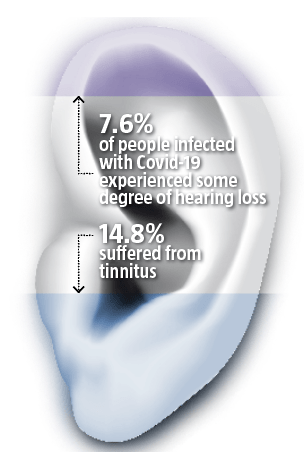
A study from the University of Manchester and Manchester Biomedical Research Centre published in March found that 7.6 percent of people infected with Covid-19 experienced some degree of hearing loss, 14.8 percent suffered from tinnitus and 7.2 percent reported vertigo.
Possible mechanisms for Covid tinnitus include direct viral infection of the inner ear or the nerves, an inflammatory attack of immune cells or antibodies on components of the ears or nerves, or the production of blood clots that block blood supply to the very sensitive cells of the cochlea, starving them of oxygen.1
The same processes underlying Covid infection-related hearing problems could be underlying the thousands of reports of tinnitus and other ear disorders following Covid vaccination. The UK’s Yellow Card reporting system recorded 9,210 reports of people who developed ear disorders after receiving Covid shots.
These included 3,497 reports of tinnitus, 2,663 of them following jabs of AstraZeneca’s Covid vaccine. While these reports are not confirmed as caused by the vaccine (nor are those reports following Covid confirmed as caused by the infection), they are temporally related and there seems to be a common picture emerging.1
A private Facebook group called Covid Vaccine-Induced Hearing Loss and Tinnitus has already attracted nearly 700 members, who describe their sagas of ringing, buzzing or hearing loss beginning within minutes or hours and sometimes weeks after getting Covid shots—and staying.
One woman posted to the group in May that she developed tinnitus in her right ear three days after getting her first dose of Pfizer’s Covid shot in April. “At times the roaring is so loud I cannot stand it,” she wrote. “Went to see ENT [ear, nose and throat specialist] who gave me prednisone. Has anyone here tried prednisone? Also very reluctant to get second shot. ENT advised against it. . . Does this ever go away?”
Tinnitus tends to increase with age, and studies have found that hearing loss is associated with dementia and impaired memory, but a 2019 study published in Scientific Reports was the first to look at tinnitus, Parkinson’s and Alzheimer’s diseases systematically in a population-based way.
A team of Taiwanese researchers used health records to identify 12,657 tinnitus patients and 25,314 control patients without tinnitus. Over a 10-year follow-up period, 398 of those with tinnitus (3.1 percent) and 501 without (2.0 percent) developed Alzheimer’s, and 211 tinnitus patients (1.7 percent) and 249 control patients (1.0 percent) developed Parkinson’s.
After adjusting for other potential influencing factors like diabetes, head injuries and income, the researchers determined that patients with tinnitus were 1.54 times more likely to develop Alzheimer’s and 1.56 times more likely to develop Parkinson’s.
A possible mechanism for the relationship between tinnitus and neurodegenerative diseases may be inflammation, which is common to many chronic disorders. This fits with the post-Covid and post-infection onset of tinnitus, too, and opens up new lines of treatment possibilities that mainstream medicine isn’t offering.13
For the most part, mainstream medicine has a “get used to it” approach to tinnitus, once pressing dangers have been ruled out. Doctors suggest masking techniques like white noise and fans to distract from the noise, psychological approaches like cognitive behavioral therapy to retrain the brain to accept the noise as background, or meditation to help with anxiety and acceptance.
White noise apps abound, and some tinnitus sufferers say they function best if soft music is playing in the background. YouTube offers an assortment of tinnitus playlists from hours of ocean waves and babbling brooks to Tibetan wind chimes and bird noises.
But masking the problem does not solve the problem, so when patients were asked how effectively their healthcare provider was able to manage their tinnitus, it’s not surprising that 83 percent replied, “not at all effectively” or “not very effectively.” Only 3.5 percent thought that their tinnitus had been managed “very effectively” or “extremely effectively.”14
But there are things that have definitely brought some people relief. Here are a few of the most popular and promising simple therapies and supplements.
Oxygen free radicals have been connected to age-related and noise-induced hearing loss. A 2019 randomized, double-blind, placebo-controlled study by researchers at the University of Athens School of Medicine found that supplementation with the antioxidant alpha-lipoic acid (ALA; 300 mg twice a day) and a multivitamin with minerals reduced the subjective discomfort and intensity of tinnitus. Those in the placebo group reported no change.15
Vitamin B12 deficiency has also been linked to both an increase of oxidation and the development of tinnitus. In one study of military personnel, 47 percent of those with noise-induced hearing loss and tinnitus were deficient in vitamin B12 compared to 19 percent of those with normal hearing.16
In a more recent randomized, double-blind study,
43 percent of patients with chronic tinnitus had vitamin B12 deficiency, and they experienced a significant improvement in tinnitus severity after weekly injections of 2,500 mcg vitamin B12 for 6 weeks.17 One 2018 study also found that 28 percent of a small group of tinnitus sufferers (without hearing loss) had a measurable clinical improvement after taking a multi-B vitamin for just one month.18
Another antioxidant that may impact tinnitus is coenzyme Q10 (CoQ10). One study found that tinnitus patients with a low serum level of CoQ10 who took 300 mg CoQ10 daily for 12 weeks reported significant improvement in their tinnitus severity.19
Coffee is another antioxidant with a tinnitus effect. A 2018 study found that daily coffee consumers between the ages of 19 and 64 had 50–70 percent less hearing loss than those who only drank coffee rarely, and the more coffee consumed, the lower the level of tinnitus. Not surprisingly, the Korean researchers found that brewed coffee had a more protective effect than instant.20
Suggested daily dosages: alpha-lipoic acid, 300 mg per day; multivitamin-multimineral complex, follow the label instructions; CoQ10, 300 mg daily
The Chinese have used the leaves of the Ginkgo biloba tree in their traditional medicine for thousands of years. A 2020 review of the medical literature on Ginkgo biloba for tinnitus found that testing with inadequate doses may be responsible for some studies that found no effect compared to those that did.
“All studies, however, assessed the most important component of treatment success—the patients’ perception of their own tinnitus,” the paper by researchers at University of Central Florida College of Medicine and the Michigan Ear Institute concluded. “Based on this evidence, Ginkgo biloba ought to be in the
treatment repertoire of a physician’s approach to patients with tinnitus.” 21
Suggested daily dosage: 240 mg of Ginkgo biloba twice daily. Do not take ginkgo if you have a bleeding disorder, are planning surgery, or have diabetes, epilepsy or fertility problems—unless your doctor recommends it. Do not eat untreated parts of the ginkgo plant which are toxic
Animal studies have shown that the inner ear has a high content of the essential mineral zinc, and low zinc levels correlate with tinnitus. Nevertheless, the effects of zinc supplementation on the condition have been conflicting, with some groups benefiting more than others. Among elderly tinnitus sufferers with lower zinc levels in one study, 82 percent responded favorably after supplementing with zinc for eight weeks.21
A study of 2,225 participants, including 460 with tinnitus, found that blood zinc levels were only significantly lower in those with extreme tinnitus,22 while another study found that patients with tinnitus and normal hearing had significantly lower levels of zinc than healthy controls, as compared with patients with tinnitus and hearing loss, who showed no significant difference in zinc levels to healthy controls.23
Tinnitus patients with hearing loss may still benefit from supplementing with zinc, however; in one study 85 percent of patients with noise-induced hearing loss (NIHL)-associated tinnitus reported a significant improvement in Tinnitus Handicap Inventory scores following two months of taking 40 mg zinc daily.21
Suggested daily dosage: 40 mg zinc daily
Magnesium is another mineral that is essential to cellular and nervous system function. Research has found that serum magnesium levels of people with severe “catastrophic” tinnitus were lower than those of healthy controls.24 A small study of 26 patients who took 532 mg of magnesium daily found they had statistical improvement on the Tinnitus Handicap Scale after three months.25
Suggested daily dosage: The US National Institutes for Health safe upper limit for magnesium supplementation is 350 mg daily. Make sure you are eating enough organic magnesium-rich foods like spinach, kale, swiss chard, turnip, beet and collard greens and broccoli. Epsom salt baths also boost magnesium uptake.
It’s not entirely surprising that vaccines could injure the ears similar to infections, since other drugs are well-known to cause hearing disorders. “Ototoxicity” is the term for drugs that have the known side-effect of toxicity to the ear, specifically the cochlea or auditory nerve, and may cause reversible or permanent hearing loss and tinnitus.
Drugs to watch out for include:
Aspirin and nonsteroidal anti-inflammatory drugs (NSAIDs) including painkillers like ibuprofen (Motrin and Advil) and naproxen (Aleve) have been shown to cause tinnitus in some people who have taken them at high doses or for long periods of time.1
ACE inhibitors and angiotensin receptor blockers (ARBs) used to lower blood pressure may cause ringing in the ears. In a study of adverse drug reactions, one ARB in particular, irbesartan (Avapro), was found to stack the odds of developing tinnitus. The ACE inhibitor ramipril (Altace) did as well.2
Antibiotics that end in “mycin,” including streptamycin, gentamicin (Gentafair), tobramycin (Tobrex), azithromycin (Zithromax or the Z-Pak) and clarithromycin (Biaxin), all have a well-documented potential side-effect of hearing loss and tinnitus when prescribed systemically and should especially be avoided in pregnancy as they can damage a developing baby’s ears, too.3
Fluoroquinolone antibiotics like ciprofloxacin (Cipro), over-prescribed for UTIs, and moxifloxacin (Avelox) used for bacterial infections have been reported to cause tinnitus in case studies.
Beta blockers including bisoprolol (Zebeta), nebivolol (Nebilet, Bystolic) and timolol are used to treat high blood pressure and are linked to tinnitus.2
A very popular Reddit post about a simple hands-on technique to alleviate tinnitus was made into a YouTube video in 2017 that has nearly three million views.5 It features people with severe chronic tinnitus cupping their hands over their ears, stacking their index finger on top of their middle finger and then driving the index fingers down so they thwack the base of their skull about 50 times. Roughly half of the people who try the technique reportedly have noticeable relief. A woman in the video cries as she hears silence for the first time in years. There are hundreds of comments on the video from people saying the technique helped and from those which it didn’t.
One study found that tinnitus patients are five times more likely to have myofascial trigger points—hyper-irritable or tender spots with palpable nodules in taut bands of muscle fiber—than people who did not suffer from tinnitus.
A double-blind, placebo-controlled, randomized clinical trial by a physiotherapist and ear, nose and throat specialist at the University of São Paulo Medical School divided 70 people with tinnitus into two groups: half received 10 sessions of myofascial trigger point “deactivation” through manual pressure, and the other half, the control group, received sham treatment. Those in the treatment group had diminished trigger point pain and improvement in their tinnitus.26
There may be a new noninvasive way to bring relief to tinnitus sufferers using a device that combines sounds with zaps to the tongue, according to a study published in October 2020 in Science Translational Medicine.
Hubert Lim, an associate professor of biomedical engineering and otolaryngology at the University of Minnesota, had discovered that electrically stimulating some neurons in the tongue or on the face can activate cells in the auditory system. Weird as it sounds, some people recount this kind of trigger as the beginning of their tinnitus nightmare.
Popular Irish broadcaster Derek Mooney recently told The Irish Sun that he believes his 20-year “hell” of the sound of a leaking pipe in his ears was set off by a tool used when he got a shave in a Dublin barbershop.
“My memory is that they used a little mechanical device after it to massage my chin,” he said. “The vibration went into my jaw, and when I came out, there was this noise in my left ear. I’ve had it ever since.”
Lim’s treatment targets the brain cells that are firing out of whack. It’s based on animal and human studies that have found that by delivering a zap to the touch-sensitive neurons in the tongue with a broad range of soundwaves, the brain cells can be reset.
The technique is called bimodal neuromodulation. Lim’s recent randomized, double-blind study involved 326 adults who used a Lenire device for one hour a day for 12 weeks. Sixteen percent of participants dropped out of the study, but 81 percent of those who completed the treatment had improvements in quality of life markers such as better concentration or sleep and reduced anxiety. For about 77 percent of the group, the benefits lasted a full year.1
The Lenire device is being sold by Neuromod, and practitioners in Ireland and Germany are offering the service, which needs training to operate. More research is underway to bolster the chances of Food and Drug Administration approval for distribution in the US.2
A similar device has been developed by a group at the University of Michigan, led by professor of otolaryngology Susan Shore, but it pairs the sound heard by the patient with tinnitus—Mooney’s leaking pipe pitch, for example—with a specifically timed electrical pulse to the head or neck. Early preclinical trials suggest the device works to reduce the severity of tinnitus.3
Stick your tongue out to tinnitus
|
References |
|
|
1 |
Sci Transl Med, 2020; 564: eabb2830 |
|
2 |
www.lenire.com/the-science-of-lenire |
|
3 |
University of Michigan Fast Forward Medical Innovation, innovation.medicine.umich.edu/portfolio_post/shore |
Drug damage
|
References |
|
|
1 |
Drug Saf, 1993; 9: 143–8 |
|
2 |
Front Pharmacol, 2019; 10: 1161 |
|
3 |
Merck Manual (Professional). “Drug-Induced Ototoxicity,” April 2020. www.merckmanuals.com |
Vaccine reaction
|
References |
|
|
1 |
UK Medicines & Healthcare Products Regulatory Agency, “Coronavirus vaccine – weekly summary of Yellow Card reporting.” Updated 27 May 2021. www.gov.uk |
Post-Covid tinnitus
|
References |
|
|
1 |
Int J Audiol, 2021 Mar 22; 1–11 |
MAIN ARTICLE
|
References |
|
|
1 |
Mil Med, 2019; 184(Suppl 1): 604–14 |
|
2 |
Sci Rep, 2020; 10: 12134 |
|
3 |
American Tinnitus Association, May 22, 2014, “Treating and Curing Tinnitus Is Part of Our National Commitment to Veterans.” www.ata.org |
|
4 |
BMJ, 2016; 354: i4108 |
|
5 |
youtu.be/KBgkPOGD6gw |
|
6 |
Daily Star, June 2, 2020. |
|
7 |
Sci Rep, 2016; 6: 27109 |
|
8 |
UK National Health Service, “Nasopharyngeal Cancer.” www.nhs.uk/conditions/nasopharyngeal-cancer |
|
9 |
Hearing J, 2014; 67(5): 22–6 |
|
10 |
Int Tinnitus J, 2004; 10: 42–6 |
|
11 |
Neuron, 2011; 69: 33–43 |
|
12 |
Neuroimage Clin, 2017; 16: 196–204 |
|
13 |
Sci Rep, 2020; 10: 12134 |
|
14 |
Front Neurosci, 2019; 13: 802 |
|
15 |
Nutrients, 2019; 11: 3037 |
|
16 |
Am J Otolaryngol, 1993; 14: 94–9 |
|
17 |
Noise Health, 2016; 18: 93–7 |
|
18 |
Ann Med Surg, 2018; 36: 203–11 |
|
19 |
Otolaryngol Head Neck Surg, 2007; 136: 72–7 |
|
20 |
Nutrients, 2018; 10: 1429 |
|
21 |
Otolaryngol Clin North Am, 2020; 53: 637–50 |
|
22 |
Clin Exp Otorhinolaryngol, 2015; 8: 335–8 |
|
23 |
Auris Nasus Larynx, 2003; 30(Suppl): 25–8 |
|
24 |
Kulak Burun Bogaz Ihtis Derg, 2016; 26: 225–7 |
|
25 |
Int Tinnitus J, 2011; 16: 168–73 |
|
26 |
Braz J Otorhinolaryngol, 2012; 78(6): 21–6 |
What do you think? Start a conversation over on the... WDDTY Community

Great news! Discounts are available based on your cart total. Check the details below: