An often overlooked and poorly understood gland plays a major role in the immune system and therefore in how long we live, but it disappears in midlife. Cate Montana investigates whether we can keep the thymus around longer
For centuries the thymus was considered the most mysterious gland in the human body. The ancient Greeks understood it as the seat of the soul, and the Greek word thymos can be translated as “animus,” “smoke,” or “spirit.”
The famous Greek and Roman physician and philosopher Galen of Pergamon (129–c. 216 AD) believed the thymus was responsible for the purification of the nervous system. He was the first person in medical history to realize the thymus grows larger from birth into the teen years, reaching its maximum size of 20–50 g in weight at puberty. After that, it gradually dwindles down to a mere 5–15 g of “thymic tissue” in a process called “thymic involution.”
By the 1800s, physicians mostly believed the thymus had something to do with secreting a “fluid form of nourishment” during youth. For many years it was blamed for what is now termed sudden infant death syndrome.
As well, for decades, the thymus was considered a “childhood organ” with little relevance in adulthood. This erroneous view didn’t shift until 1961, when its actual role as the master gland regulating the body’s immune system response was discovered by Australian immunologist Jacques Miller.
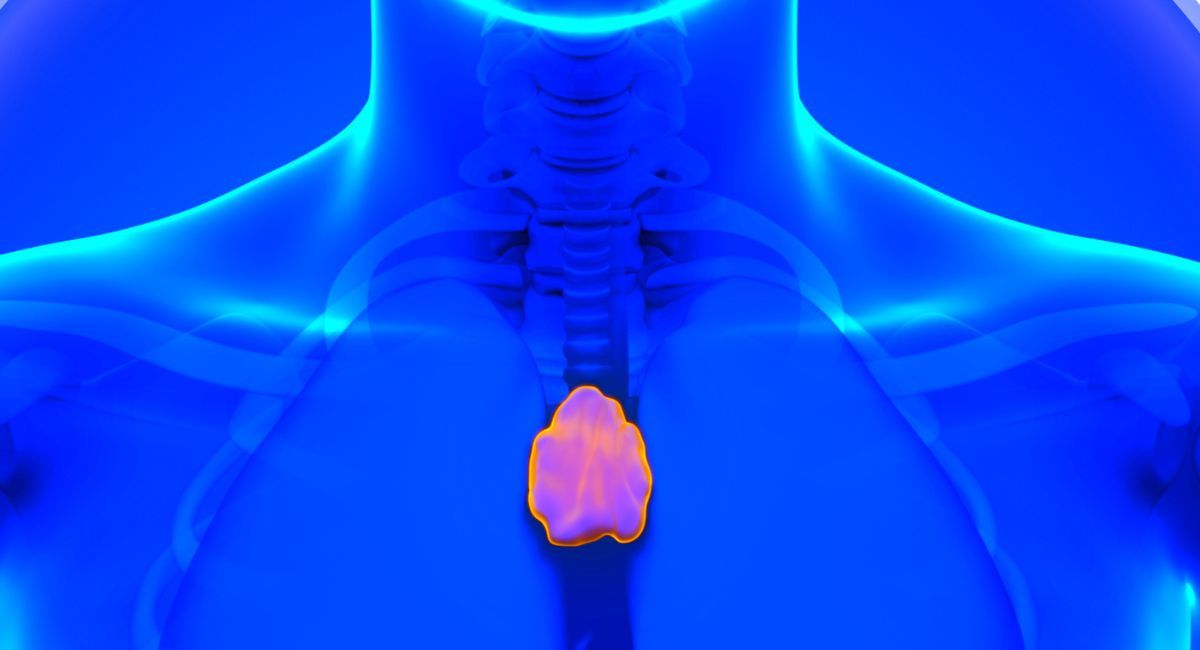
With an arrowhead shape that vaguely resembles a leaf of thyme, the thymus gland has two encapsulated lobes and is located in the upper front part of the chest, behind the sternum and in front of the heart. It creates special white blood cells called T lymphocytes or T cells, which travel through the bloodstream into the lymph system and other organs, helping the immune system fight infection and disease.
Most T cells are produced by the thymus gland before birth as the body gestates. The rest are created before puberty, at which time the gland will have supposedly produced all the T cells required for immune protection against disease for the rest of a person’s life.
However, this assumes that environmental living conditions today are the same as they were hundreds of thousands (if not millions) of years ago, when this gland’s function was still evolving. But such is definitely not the case.
“When you’re born and then an infant, you’re susceptible to acute infections, and they can be life-threatening,” says Dr J. E. Williams, integrative medicine clinician, acupuncturist, doctor of Oriental medicine and founder of the San Diego Clinic of Natural Medicine (drjewilliams.com). “So, the thymus is really that protective immune system component that gives you some chance of surviving against infection.
“By the time you’re about 12 years old, you’ve survived the worst possible conditions. The body is supposed to be in some sort of homeostasis with its environment by that time, and the thymus gland starts to involute. (Involution is a process of functional tissue replacement by fat.) Basically, the thymus has done its job, and that’s why it diminishes,” he suggests.
This glandular reduction might well explain why Covid-19 has fewer effects on children with fully functional thymus glands than on the elderly, who are much more susceptible. But to this day, no one actually knows for sure why thymus function peaks when we’re children and weakens as we age.
One would think the thymus would stay strong throughout life or even get more powerful as we get older and more vulnerable to life’s slings and arrows. However, thymic involution starts in our early 20s. The process is difficult to measure precisely in older adults, but studies show thymic tissue decreases rapidly until about age 54, at which point it’s been completely replaced by fat.1
Was this degenerative replacement system all that evolving human beings needed a million years ago? After all, back then most likely nobody traveled far from their birth ecosystem. Early humans didn’t fly to the other side of the planet or go to rock concerts and sports stadiums filled with people from many nations and many strange environments.
Early men and women might not have needed their thymus glands cranking out T cells 24/7 into their 80s. Perhaps the body’s backup plan could more easily maintain health and physiological homeostasis with bone marrow and spleen taking up the slack, producing any T cells required to handle “cell-mediated immunity” later in life.
Today, of course, studies show that genetic diversity and the coming together of ethnic and racial groups significantly increase the incidence of diseases, autoimmune disorders and cancer risks and certain cohorts’ susceptibility to them.2
Increased air pollution, wildfires, extreme weather events and biodiversity loss “significantly disrupt” the human immune system, resulting in the production (and often over-production) of antigens, allergens and microbiota changes in the human body. These changes can trigger a broad spectrum of autoimmune conditions, allergies, metabolic diseases, respiratory illnesses and more.3
Because the immune system follows a circadian rhythm, the chance of picking up an infectious disease varies with the time of pathogen exposure.4 Which means hopping on that redeye flight from New York to London or taking that late-night security job at the local hospital has direct health consequences.
The need for a strong immune system to extend our healthy lives is clear, but the question remains: Is there anything we can do to prolong the life of the thymus and the disease-fighting benefits it gives us? Scientists are working to better understand its role in hopes of learning more about why it involutes.
In addition to T cells, which are distinguished from other lymphocytes by the presence of a T cell receptor on their cell surface, the thymus secretes signaling proteins called cytokines. These help control inflammation by influencing the specialization and migration of T lymphocytes throughout the body. As the thymus shrinks, it switches from producing T cells to “training” white blood cells produced in the bone marrow and spleen to become specialized T cells.
As part of the endocrine system, early in life, the thymus also makes thymic hormones that help immune cells to mature, programming them to recognize tissues as either “self” or “invader.” Studies show the failure to distinguish self from non-self is the basis of autoimmune disease.
Reduced thymus function, which includes reduced T cell production and thymic hormone production, directly results in at least 16 different autoimmune conditions, including these:
“Thymus function undoubtedly plays a role in autoimmune diseases,” agrees Dr Michael T. Murray, ND (doctormurray.com), co-author of the bestseller Encyclopedia of Natural Medicine (Atria Books, 2012). “But its functionality has other impacts.
“For example, the thymus can trigger a cytokine storm if it’s dysregulated. If the ratio of helper to suppressor T cells is high, then you’re going to be susceptible to allergies, migraine headaches and autoimmune diseases. When the ratio is low, you’ll be more susceptible to infections and even cancer.”
One thymic hormone, thymopoietin, fuels the production of T cells. And it tells the pituitary gland when to release its own specialized hormones—for example, the growth hormones so critical in childhood, the luteinizing hormone (LH) that stimulates ovulation and testosterone production, and the thyroid-stimulating hormone (TSH) that manages metabolism and energy levels throughout the body.
The hormones thymosin and thymulin help make specialized T cells. The thymus also produces peptides and interleukins, a class of immune-modulating molecules like IL-6 that influence the inflammatory response to infection and help in beating cancer.
Considering its increasingly prominent role in immune function and its broad-spectrum influence on so many bodily systems, it’s not surprising that studies with titles like “Thymus Renaissance Poised to Boost Health and Longevity” are cropping up on the internet. Biotechnology companies are starting to focus on regenerating the thymus or, at the very least, racing to synthetically replicate its functions. Thymus supplements and treatments are becoming more and more popular.
“It’s trendy now,” says Williams. “Unfortunately, there’s a lot of ignorance out there about the thymus and thymus health. Thymus therapies are expensive. And there’s a lot of money being made on perpetuating misinformation.
“Yes, with several hundred thousand patient visits over the last 50 years, I’ve used a lot of thymus-supportive therapies, including cow or pig thymus tissue extracts that do seem to support immunity, are useful in cancer therapies and can be valuable for longevity (see Dr Williams’s thymus protocol, below). In other words, our patients felt better, looked better and were more active with thymus support.
“But it’s not magical. At age 60, you’re not going to stimulate your thymus if you basically don’t have one anymore.”
This reality begs the question: If the thymus shrinks and disappears when we’re in our 40s or 50s, why try to preserve it? And if it shrinks so early, why is it the key to anti-aging?
The answer, as best it is possible to tell, is this: Thymus involution has been linked to aging and age‐related infectious diseases, autoimmune issues including chronic inflammation, cancer and all‐cause mortality.6 If you’re interested in keeping your body youthful for the longest possible time, starting to take care of the thymus gland even in your 20s makes a lot of sense.
As the primary site of T cell training and development in later years, even as we age, the thymus plays an important role in adaptive immune response. Bolstering and eventually replacing the thymus’s role later in life is the best way researchers currently know how to address flagging immune function and aging.
And, since repair of the thymus by the body is (as yet) impossible, the demand for other methods of replicating thymus function through the use of cytokines IL-7 and IL-22, hormone modulation, precursor T cells and thymus bioengineering creates an enormous money-making opportunity for research and pharmaceutical companies.7
Researchers are in hot pursuit of anti-aging protocols involving the thymus gland. In 2015, the first human clinical trial—the Thymus Regeneration, Immunorestoration and Insulin Mitigation (TRIIM) trial—explored whether certain aspects of human aging could be mitigated and/or reversed using human growth hormone and insulin-like growth factor 1 (IGF‐1).
Both of these have been proven to have pro‐aging effects. However, the study applied them for only a limited time while introducing the steroid hormone precursor DHEA, which is normally made in the adrenal glands, gonads and brain. The study also used the drug metformin, which is normally prescribed to lower blood glucose in those with type 2 diabetes.
The lack of surviving thymic tissue after age 54 made successful thymus regeneration impossible in older trial participants (How can you regrow something that no longer exists?). Still, the trial did produce evidence of some thymic regeneration as well as improvements in age-related disease risk factors in 10 men aged 51–65.6
But here’s the rub: Such studies are preliminary and show relatively unimpressive results given the risks involved.
The thymus is sensitive to injury from a wide variety of sources, including medical meddling. Chemotherapy has a marked negative impact on the gland, as does radiation treatment for various cancers. Sex steroid hormones—androgens, estrogens and progestogens—and corticosteroid therapy both cause dramatic thymic atrophy.
Congenital disorders affecting thymic development (athymia) can be fatal if left untreated. HIV infection severely damages the gland, as do invasive fungal infections and congenital syphilis. And then there’s stress.
Exposure to environmental toxins, such as cigarette smoke and other pollutants, negatively affects thymus function. Chronic physical stress in rat models reveals reduced thymic functionality.8
Emotional stress also disrupts the homeostatic balance of the immune system and can drastically reduce the size and functionality of the thymus gland, creating a condition known as acute thymic involution—aka rapid thymic atrophy.9 Which shines a light on the more subtle aspects of this mysterious gland.
In Traditional Chinese Medicine (TCM), there isn’t a reference to the thymus in particular. From that perspective, everything is connected to everything else. The thymus is embedded in the heart chakra, which contains the heart, the pericardium (the heart protector, a membrane that surrounds the heart) and the thymus gland.
Cadie Selah (Federmeyer), LAc, MSOM, from Bellingham, Washington (cadieselah.com), points out that in TCM, this area is responsible for human relational dynamics. The state of this region affects our capacity for intimacy, vulnerability and closeness with others.
“You could say the heart is sort of the center of our emotional body or our relating body,” says Selah. “So, we have to see it as embedded in this system of relationship. But the symbolic role of the thymus in Chinese medicine is the ‘higher heart.’ It has a relational dynamic with the divine. It’s the seat of the soul. The pericardium or ‘lower heart’ is more about our human relations.”
Which takes us right back to the ancient Greeks and thymos—“animus,” “smoke” or “spirit.”
When we experience emotional pain, suppressed emotions, stress and a lack of spiritual connection, Selah says, it affects the entire heart region, including the thymus. That means one way of maintaining a healthy, functioning thymus gland is by maintaining healthy human relationships, a healthy connection with the earth and spiritual comfort.
“Maybe it’s not as active or as big,” says Selah. “Maybe there’s some physiological and spiritual wisdom to its reduction that we don’t know about yet. But just because the thymus gland becomes shrunken doesn’t mean there’s no energetic activity.
“A multi-therapeutic approach is really key. Yes, nutrition is important, and so is supplementation. But anything you can do to heal old traumas, clean up the past and resolve emotional issues helps the thymus. That’s the idea of treating at the root.”
Researchers who study aging recommend starting to protect your thymus at around 35 years of age and becoming very proactive by ages 45–55. But what does that really mean?
“Stay away from sugar!” says Dr Michael T. Murray. “And stay away from negative emotions, anxiety, stress, depression, anger. All those things depress thymus function, and cortisol, the stress hormone, causes thymic involution. Lastly, you’ve got to get enough sleep and exercise—aerobic exercise, preferably—and follow a healthy lifestyle.”
A balanced diet rich in vitamins and minerals is essential for thymus function. Make sure you get enough of these:
When a new patient comes in, Dr J. E. Williams requests any kidney- and liver-related laboratory work done by other physicians. An MRI or CT scan may be used to determine the size of the thymus gland.
He always orders a complete blood count with “differential,” which shows the types of white cells present, including the T cells. “This shows me whether we need to support their immune function or not,” he says.
“On average, about 50 percent of those aged 45–55 who come to me are starting to show early signs of aging, others are doing moderately okay and some are not doing well at all. Those with cancer, previous cancer or recurring infections also start the support protocol,” which is as follows:
Williams’s thymus support cocktail:
As Eastern medical philosophy points out, where attention goes, chi energy flows. This means most of Cadie Selah’s thymus protocol involves stimulating the heart chakra using these acupuncture points:
Other effective self-treatments include the “Thymus Thump” developed by energy worker and healer Donna Eden. Tapping with the fingertips around the thymus area brings activation and energy to the gland.
“A slightly altered state—getting into a relaxed alpha brainwave state—can occur from any sort of tapping like this when we’re really attuned and paying attention,” says Selah. “This rhythmic tapping on the acupoints is basically an attunement of love towards yourself, getting past the conscious mind, almost like somatic hypnotherapy.”
She also recommends these approaches:
What do you think? Start a conversation over on the... WDDTY Community

Great news! Discounts are available based on your cart total. Check the details below: